



photographed at the Ministerial High-Level on the Launch of the Second Global Stock Take, captures the dilemmas of the COP31 negotiations. Credit: UN Climate Change/Kiara Worth
ANTALYA, Türkiye, November 18 (IPS) – You cannot build a wind turbine, electric vehicle, battery or solar grid without critical minerals. Lithium, nickel, cobalt, graphite and rare earths are as essential to the clean-energy transition as renewable power itself.
Yet at COP31 in Antalya, where governments are negotiating how to deliver a “just transition” away from fossil fuels, critical minerals remain largely absent from the political spotlight. While negotiators debate fairness, jobs and decarbonisation, countries elsewhere are forging mineral alliances, securing supply chains and pursuing strategic resource deals outside the UN climate process.
The disconnect raises a central question: Can the global energy transition be called just if it fails to address where the minerals will come from, who controls them, and who bears the environmental and social costs of extracting them?
That question sits at the heart of an emerging debate at COP31. The transition to clean energy depends on a vast expansion of mineral extraction, yet the governance systems needed to ensure fairness, accountability and community participation remain fragmented and incomplete.
Whose Minerals, Whose Future?
For Indigenous peoples, the debate is not theoretical.
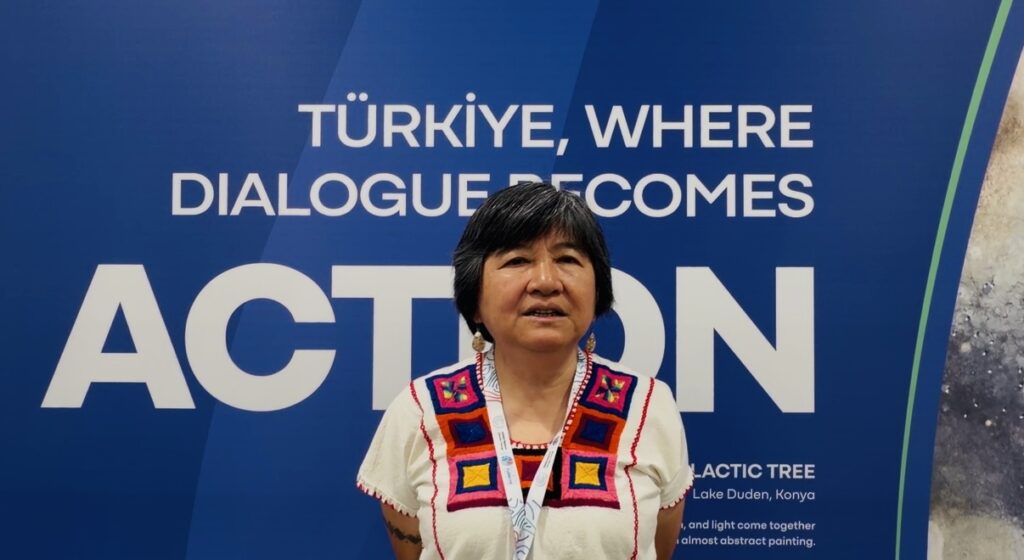
Joan Carling, a 2024 Right Livelihood Award laureate and executive director of Indigenous Peoples Rights International (IPRI), said the transition to a low-carbon economy must not come at the expense of Indigenous communities.
According to Carling, Indigenous territories hold an estimated 54 percent of critical mineral deposits. That makes Indigenous communities central to the energy transition, whether they are included in decisions or not.
Carling acknowledges an important breakthrough achieved at COP30 in Belém, where negotiators recognised Indigenous peoples’ rights to land, territories, resources, self-determination and free, prior and informed consent. It was a milestone, she says, but recognition alone is not enough.
“It’s our resources; it’s going to be our minerals, and our lands will be used for the transition. We’re not at the table. We’re not the ones taking the decisions,” Carling said.
Her concern extends beyond representation. As demand for transition minerals rises, she fears the world could simply replace one extractive model with another.
“Just moving away from fossil-fuel extractivism to extractivism again for critical minerals,” she said.
The consequences, she argues, are already visible in many Indigenous territories.
“We’ve already seen the legacy of mining, which has completely devastated our territories, destroyed our livelihoods and our food systems, and polluted rivers and water bodies,” she said.
For Carling, the issue is not merely whether mining should occur, but who gets to define the terms under which it takes place. Indigenous peoples, she argues, continue to be treated primarily as stakeholders to consult rather than as rights-holders with decision-making authority.
As global demand for critical minerals accelerates, many Indigenous leaders fear that climate goals could become the latest justification for projects imposed on communities without meaningful participation. In that scenario, the transition may reduce carbon emissions while reproducing long-standing patterns of exclusion and extractivism.

A Fight Over the Meaning of ‘Just’
Inside the COP31 negotiations, advocates are working to ensure that the transition is not discussed solely in technical or economic terms.
While critical minerals are largely absent from the draft political declaration, they have not disappeared entirely from the discussions.
Negotiators at COP31 are currently working to establish a Just Transition Mechanism intended to help countries translate broad commitments into practical action.
The mechanism is expected to be one of the principal outcomes of the COP31 talks, making debates over rights, participation and value addition especially important for mineral-producing communities.
Annabella Rosemberg, senior adviser on just transition at Climate Action Network (CAN), says the evolving Just Transition Mechanism includes references to mineral extraction, Indigenous rights, local participation and value addition.
For Rosemberg, however, the larger challenge is ensuring that social justice receives the same attention as technological deployment.
“There is much more talk about electrification than there is about just transition,” she said. “What needs to be rebalanced is not only talking about targets; it’s also talking about how we centre communities.”
She argues that climate negotiations can still play an important role by legitimising alternative development models that place local communities, Indigenous rights and equitable economic benefits at the center of the transition.
“This decision on minerals is at least giving legitimacy to a different story that needs to be told,” Rosemberg said. “Where rights are important, where community voices are important, and where value addition is important.”
Still, she warns that progress on language does not automatically translate into action.
“We’re getting great language on just transition,” she said. “But we need to have something that has some teeth to make it happen.”
That challenge runs through many of the discussions at COP31. Negotiators increasingly agree on broad principles, but implementation remains uncertain. Without stronger institutions, clearer accountability mechanisms and dedicated financial support, advocates fear that commitments to justice could remain largely aspirational.
The risk, Rosemberg says, is that communities see endless consultations, reports and policy statements while decisions continue to be made elsewhere.
Producer Countries Seek a Bigger Share
The debate extends beyond Indigenous communities to countries expected to supply the minerals needed for the energy transition.
Brazil, for example, possesses significant reserves of graphite, nickel, lithium, niobium and rare earths. In September 2026, the country adopted a National Policy on Critical and Strategic Minerals and established a dedicated council within the Presidency, signalling a growing recognition of the sector’s strategic importance.
“There is no energy transition without mining,” said Gabriella Salazar, a Brazilian mining law specialist.
As demand for minerals grows, countries like Brazil face a familiar dilemma. They possess the resources required by industrialised economies but risk remaining suppliers of raw materials while higher-value manufacturing and processing activities occur elsewhere.
Salazar argues that producer countries should have opportunities to capture more of the economic value generated by the transition.
“My suggestion would be for the COP31 just transition outcomes to formally recognise critical minerals as an integral part of the energy transition supply chain,” she said.
Such recognition, she argues, could help unlock investment, technical cooperation and capacity-building that would allow producing countries to move beyond extraction and into refining, processing and manufacturing.
The question of value addition has become a recurring theme among developing countries. Many governments see the clean-energy transition not only as an environmental necessity but also as a potential development opportunity. Whether that opportunity materialises may depend on how future supply chains are structured and who captures the greatest economic benefits.
COP Talks, ASEAN Acts
The debate has now spread beyond COP31 negotiations.
While negotiators in Antalya debate the principles of a just transition, governments elsewhere are moving to secure access to the minerals needed to power it.
On November 17, leaders gathered for the 46th ASEAN Summit in Manila, where critical minerals were among the issues expected to be discussed, according to Australian Prime Minister Anthony Albanese. Yet unlike artificial intelligence and regional economic cooperation, critical minerals did not emerge as a prominent feature of the summit’s official outcome statement.
That absence reflects a broader trend. Rather than being addressed through a dedicated multilateral framework, questions of mineral security, processing capacity and supply-chain resilience are increasingly being pursued through regional discussions, bilateral agreements and strategic partnerships.
An IISD analysis of more than 200 recent trade and economic agreements found that 139 contained critical-mineral provisions, highlighting how mineral diplomacy is largely advancing outside the UN climate process.
Among them is the France-Malaysia agreement on critical minerals cooperation, signed ahead of COP31, which aims to strengthen collaboration on mineral supply chains, processing and investment. Critical minerals have also featured prominently in discussions among the Quad countries, reflecting mounting concern over access to the resources needed for the energy transition.
The contrast with COP31 is striking. While negotiators in Antalya focus on emissions reductions, climate finance and the principles of a just transition, many of the practical decisions shaping future mineral supply chains are increasingly being made elsewhere.
The result is a widening governance gap. Climate negotiators are debating what a just transition should look like, while the architecture of the critical-minerals economy is taking shape beyond the COP process.
The Missing Global Rulebook
That fragmentation worries Michael Franczak, an economic governance researcher at the United Nations University Centre for Policy Research (UNU-CPR) and co-author of the recent report, Governing Critical Minerals: Advancing Global Cooperation in a Fragmented Landscape.
“Critical minerals may be absent from the official COP31 agenda, but they are hovering over everything,” Franczak said.
According to Franczak, no single institution currently governs the intersection of mining, energy, trade, investment, industrial strategy and development. Yet all of these sectors increasingly influence the success or failure of the global energy transition.
The absence of an overarching framework leaves countries, communities and companies navigating a rapidly evolving landscape shaped by overlapping institutions and competing priorities.
Rather than calling for a single new treaty, Franczak advocates a more pragmatic approach that is based on stronger coordination among existing organisations. Such a system could improve transparency, strengthen standards, expand participation by producing countries and create mechanisms for addressing cross-border challenges that no single institution can manage alone.
The goal, he argues, is not to slow the energy transition but to ensure that it unfolds in a fair, predictable and accountable manner.
Without that coordination, the world risks repeating mistakes that have long characterised global resource extraction, where wealth accumulates far from the places where resources are extracted.
A Race Against Time
As COP31 enters its final days, the question facing negotiators is no longer whether critical minerals matter to the energy transition.
The question is whether global governance can catch up with a rapidly accelerating mineral race before inequalities become embedded in the foundations of the green economy.
For Indigenous communities, the challenge is ensuring that rights are respected and consent is meaningful. For producer countries, it is securing a fair share of the economic opportunities created by the transition. For policymakers, it is designing institutions capable of connecting climate goals with trade, development and resource governance.
The energy transition may be essential for addressing climate change, but experts warn that its legitimacy will ultimately depend on how its benefits and burdens are distributed.
As governments rush to build the clean-energy economy, Franczak cautions against assuming that cleaner technologies automatically produce fairer outcomes.
“Without better rules and stronger cooperation, we risk repeating an old pattern: resources are extracted in developing countries, while much of the economic value is captured elsewhere and local communities bear the environmental and social costs,” he warns
IPS UN Bureau Report



© Inter Press Service (20261118142301) — All Rights Reserved. Original source: Inter Press Service
