
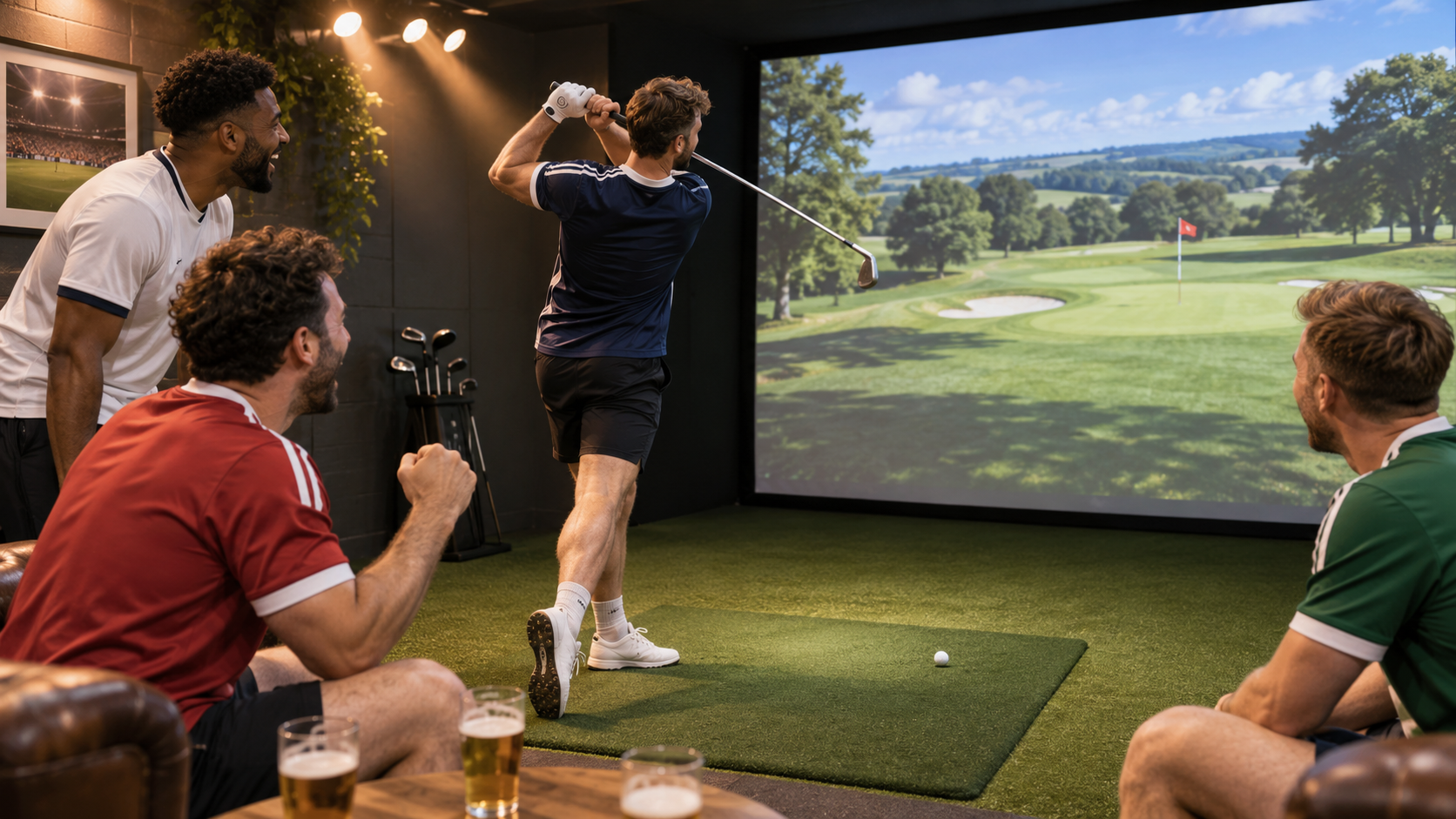

Every football fan knows what happens when someone says, “Go on then, you take it.” A casual kickabout turns into a penalty shootout, everyone suddenly has an opinion about technique, and the person who insisted it was just a bit of fun starts asking for a retake. Something similar happens when you hand that same group a golf club. Give them a virtual green and three balls each, and within minutes someone is checking the scoreboard and someone else is blaming the conditions.
That competitive streak is a big part of the appeal of golf simulators. You can play a few holes, set up a quick challenge or spend half an hour trying to beat a mate’s best shot. You can do it on a wet Sunday afternoon, between televised matches or on a midweek evening when everyone has an hour to spare.
If you’ve ever taken a penalty with your mates watching, you already understand one of golf’s biggest challenges. Hitting a stationary ball looks straightforward until you’ve picked your target and everyone has gone quiet. On a simulator, the pressure creeps in when somebody puts a shot six feet from the pin and you have one ball left to beat it.
Nearest the pin is a good place to start. Pick a short par three, give everyone three attempts and see who finishes closest. It works well with a mixed group because one good swing can beat someone who plays every weekend. If the gap in ability is wide, let beginners play from closer in or give them an extra ball. The quicker everyone gets a turn, the better the session tends to go.
A longest-drive contest is an obvious follow-up. Count only drives that finish on the fairway and you give the group something more interesting to argue about than who can swing hardest.
You hit a real golf ball from a mat into a screen. A launch monitor measures the shot and sends the data to software, which calculates where the ball would travel on the virtual course or driving range. A projector can display the result on the screen, so you see the ball fly towards the green or disappear into the rough.
Depending on the launch monitor, you might see figures such as ball speed, launch angle and carry distance. If you like digging into football stats after a match, there’s plenty to explore. If you’re new to golf, carry distance is a useful starting point. It tells you how far the ball travelled in the air, which helps you work out which club to use when there’s a bunker in front of the green.
A home golf simulator bundle can simplify the job of choosing equipment. Check what’s included in the specific bundle and whether the launch monitor, software and projector suit the room you have in mind. It’s worth doing that before picturing a full round in the garage with the Saturday scores on in the background.
A regular group can turn a few simulator sessions into a league. Keep it simple. Choose one challenge each week and award points based on finishing position. Nearest the pin might suit the first week, followed by a three-hole round, then a contest to see who can land the most balls inside a target area. Stick the results in the group chat and let the arguments about the points system begin.
Doubles work well if people have different levels of experience. In a two-person scramble, both players hit a shot, the pair chooses the better one and both play again from there. A beginner might struggle off the tee and still hit the approach shot that wins the hole. It also gives the more experienced player a reason to offer one helpful tip at a time, which everyone will appreciate.
For a session before kick-off, three holes or a handful of shots each is plenty. Save the full round for an evening when nobody’s checking the clock.
Start with the space. Measure the width, depth and ceiling height, then think about where the hitting mat will sit. Allow clearance for a full swing with the longest club you plan to use, and account for both left- and right-handed players if your group includes both. In a garage, check for overhead door tracks and light fittings. Make sure you also have the distances your chosen launch monitor requires around the ball.
The golf impact screen has two jobs in a projected setup. It takes the strike from the ball and gives the projector a surface for the image. Check the manufacturer’s fitting guidance, including how much space to leave behind it and how to tension it. Think about the sides and top of the hitting area too. An enclosure or suitable netting can help contain wayward shots, especially when someone is picking up a club for the first time.
If you want to use the room while the football’s on, plan where people will sit or stand. A clear viewing spot outside the swing and hitting area makes it easier to chat, watch the game and take turns comfortably.
The easiest first session is a warm-up on the virtual driving range followed by nearest the pin. Give everyone a few practice swings, agree on the rules and keep turns short. If someone wants to use the shot data, get them to hit five balls with the same club and see how tightly they group. That gives them something they can try to improve the next time.
Football supporters already know how much fun there is in a close contest and a bit of friendly stick afterwards. A golf simulator gives the group somewhere to play when the weather’s miserable and an excuse to make a rematch out of it. Just settle the rules on retakes before anyone hits the first ball.
What fans are reading
Popular stories published in the past 48 hours.

