
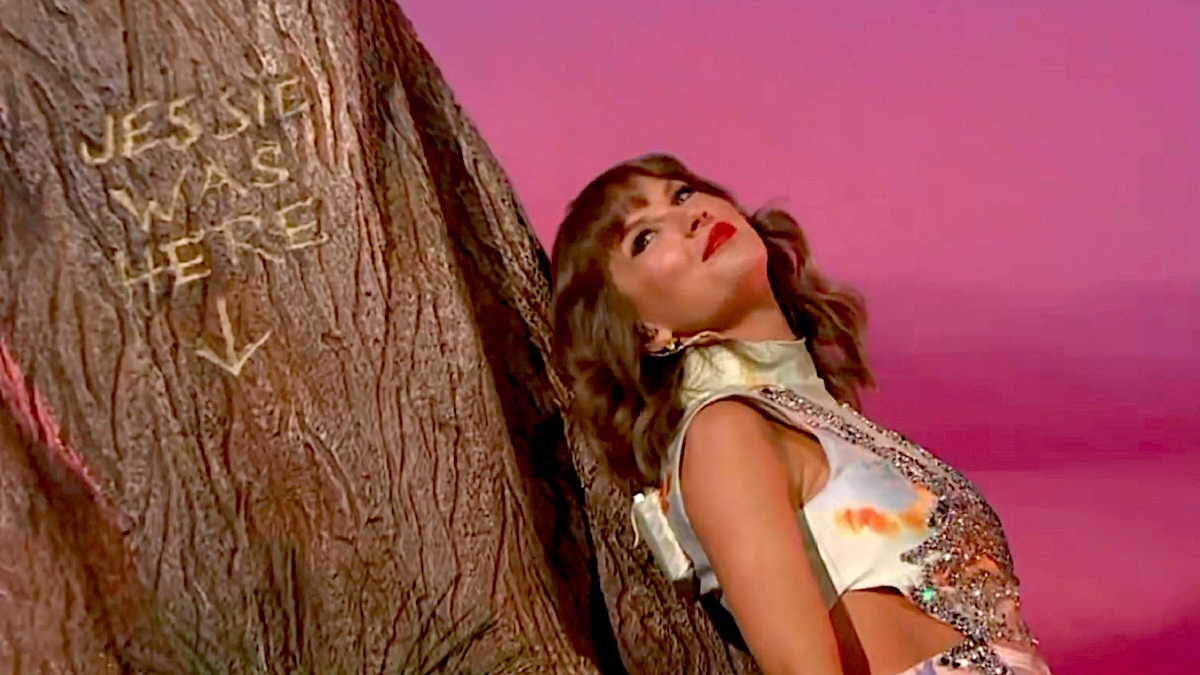


Taylor Swift returned to the CMA Awards stage on Wednesday night, playing one song each from opposite ends of her career for her first appearance at the ceremony in 13 years.
Swift kicked off the performance backstage at Nashville’s Bridgestone Arena with “I Knew It, I Knew You” from the Toy Story 5 soundtrack, which was released earlier this year. Several country artists on the evening’s bill — including Brad Paisley, Sugarland, Little Big Town, Eric Church, Lainey Wilson, and Brooks & Dunn — appeared next to her as she made her way through the venue’s hallways and toward the stage, where she was joined by Keith Urban on banjo for “Our Song” from her self-titled debut album.
Released two decades apart, both hits made for a full-circle moment as Swift revisited her country roots in a white-and-red dress with matching cowboy boots, an outfit reminiscent of Jessie from Toy Story.
Related Video
The appearance felt particularly special given Swift’s long history with the show. She first attended the CMA Awards in 2006, won the Horizon Award the following year, and became the youngest artist ever to win Entertainer of the Year in 2009 – an honor she claimed again in 2011.
Her previous CMA performance came in 2013, when she performed “Red” alongside Vince Gill and Alison Krauss. That same night, Swift received the Pinnacle Award from a group of country stars she had once opened for, including Tim McGraw, Faith Hill, George Strait, Brad Paisley, Keith Urban, and Rascal Flatts.
Swift’s most recent appearance at the ceremony before Wednesday came in 2016, when she returned to present Garth Brooks with Entertainer of the Year. A decade later, she arrived at the 60th annual CMA Awards with her 26th career nomination, earning a Single of the Year nod for “I Knew It, I Knew You.”
The return also comes shortly after her historic induction into the Nashville Songwriters Hall of Fame, where she reflected on the city’s role in shaping her as a songwriter and giving her the foundation to eventually move between genres.
🚨Taylor Swift performing a mashup of I Knew It, I Knew You x Our Song at the CMAs! pic.twitter.com/NjHEfGhb3f
— Taylor Swift Updates (@TSUpdating) November 19, 2026
