

BlackRock Executive Sees New Wave Of Wall Street Investors Entering Crypto — What It Means For Bitcoin


BlackRock’s digital assets chief, Robbie Mitchnick, believes the cryptocurrency industry is entering a new phase as more professionals from traditional finance bring their expertise to digital assets. His comments come as institutional Bitcoin demand continues to reshape the market, raising an important question: could Wall Street’s growing participation eventually transform how Bitcoin behaves in financial markets?
In an interview highlighted by Financial News on November 23, Mitchnick explained how traditional finance expertise is helping the crypto sector develop more sophisticated investment products and infrastructure.
The shift is particularly significant for Bitcoin, which has moved beyond its early reputation as a speculative digital asset to become an increasingly accessible investment through exchange-traded funds and other regulated financial products.
BlackRock Sees Traditional Finance Reshaping Crypto
Mitchnick, who joined BlackRock in 2018 as its first employee focused on blockchain technology, has witnessed the digital asset industry develop from a relatively small market into a multitrillion-dollar sector.
According to the interview, the arrival of experienced financial professionals is helping cryptocurrency businesses build the infrastructure needed to serve larger investors.
BlackRock itself has become a major participant in this transformation through its iShares Bitcoin Trust (IBIT), which holds more than $50 billion in assets, according to the November 23 report.
However, the broader opportunity extends beyond traditional Bitcoin ETFs. As Bitcoinist previously reported, BlackRock launched its Bitcoin Premium Income ETF, introducing an investment product designed to generate income through an options-based strategy.
This expansion illustrates how institutional financial products are evolving beyond simply tracking Bitcoin’s market price.
Traditional financial institutions are also exploring tokenized investment products, blockchain-based settlement systems, and digital representations of conventional assets.
For Bitcoin, this development could create a more established investment environment where access is no longer limited primarily to cryptocurrency exchanges and specialized trading platforms.
Could Institutional Investors Change Bitcoin’s Volatility?
One of the most interesting aspects of Mitchnick’s outlook concerns Bitcoin’s volatility.
Historically, Bitcoin has experienced substantial price fluctuations, partly because of speculative trading, leverage, and changes in market liquidity.
But as pension funds, wealth managers, and other long-term investors gradually increase their participation, the composition of Bitcoin’s investor base could change.
In his November 18 interview with Anthony Pompliano, Mitchnick discussed the growing preference for Bitcoin ETF exposure among certain investors and the expansion of services surrounding institutional Bitcoin holdings.
These developments could encourage longer investment horizons, although institutional participation does not guarantee lower volatility. Large fund flows and broader financial-market shocks can still produce significant price movements.
Interestingly, Bitcoin’s correlation with traditional stocks has already experienced substantial changes, demonstrating that the cryptocurrency does not always move in the same direction as conventional financial markets.
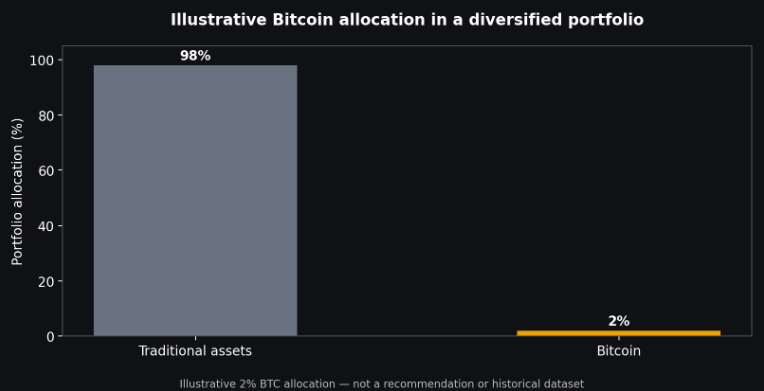
In its research report, BlackRock examined Bitcoin’s potential as a portfolio diversifier, highlighting its historically distinctive return characteristics and the potential benefits of modest portfolio allocations.
The research suggested that a measured allocation of approximately 1% to 2% could improve risk-adjusted portfolio performance in historical models, although past results do not guarantee future returns.
Why Wall Street’s Next Move Matters For Bitcoin
Another important development is the growing number of ways investors can gain Bitcoin exposure.
Rather than purchasing Bitcoin directly and managing private keys, institutions can use regulated investment products that integrate with their existing portfolio management systems.
This makes Bitcoin easier to incorporate into traditional investment strategies.
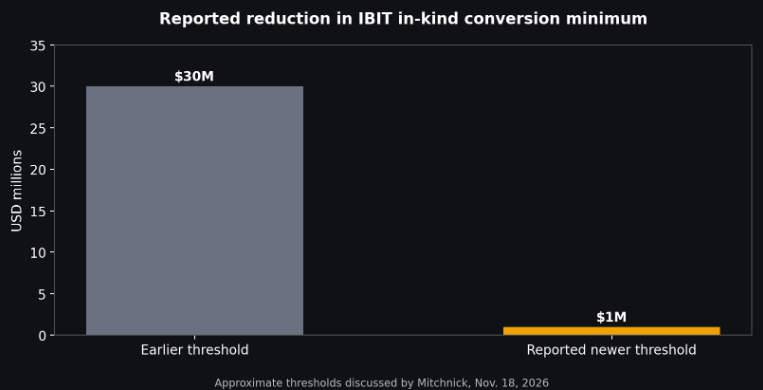
Mitchnick also discussed how investors holding Bitcoin directly are increasingly exploring conversions into ETF shares, citing benefits related to custody, estate planning, and operational convenience.
The minimum size for certain IBIT in-kind conversions has reportedly declined from approximately $30 million to around $1 million, potentially making the process accessible to a broader group of investors.
Meanwhile, traditional banks are also developing cryptocurrency infrastructure. As Bitcoinist recently reported, Deutsche Bank launched institutional crypto custody services, providing another example of how established financial institutions are expanding their digital asset operations.
These developments suggest that Bitcoin adoption is becoming increasingly connected to mainstream financial services rather than remaining concentrated within cryptocurrency-native businesses.
Still, the pace of adoption will depend on investor demand, regulation, market conditions, and whether Bitcoin continues demonstrating value within diversified portfolios.
What Comes Next For Bitcoin?
Mitchnick’s comments suggest that the next stage of cryptocurrency adoption may depend less on speculative enthusiasm and more on the integration of digital assets into established financial systems.
For Bitcoin, that represents an important long-term development.
The participation of major asset managers does not eliminate market risk, but it can expand access, improve infrastructure, and introduce Bitcoin to investors who previously faced operational or regulatory barriers.
As Wall Street continues developing new cryptocurrency products, Bitcoin could become a more familiar component of institutional portfolios.
The central question is no longer simply whether traditional finance will participate in Bitcoin, but how much that participation will reshape the market over time.
Editorial Process for bitcoinist is centered on delivering thoroughly researched, accurate, and unbiased content. We uphold strict sourcing standards, and each page undergoes diligent review by our team of top technology experts and seasoned editors. This process ensures the integrity, relevance, and value of our content for our readers.
