
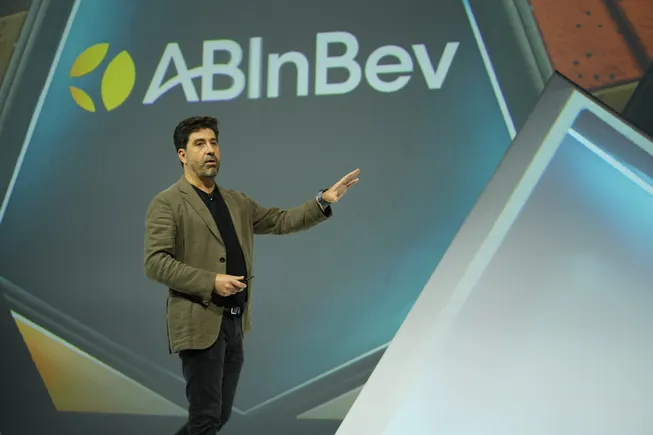

ORLANDO — AB InBev in May was named the Cannes Lions Creative Marketer of the Year, becoming the first company in the Festival of Creativity’s history to win the award for a third time. For Global Chief Marketing Officer Marcel Marcondes, the accolade wouldn’t have meant much if the creativity it was being lauded for didn’t also drive growth, like the 11% revenue increase the company saw in Q2 2026.
“We’re reaching all-time high revenues, and we see our share price having good performance,” Marcondes said during a presentation at the Association of National Advertisers Masters of Marketing conference on Oct. 21. “The business is moving [in] the right direction, and that’s the beauty of means and ends going together, hand in hand.”
The executive’s tenure as chief marketer began in April 2022 and has roughly coincided with a period in which AB InBev changed its strategy after years of growing primarily through acquisition and consolidation.
“For every company that wants to grow organically, the only way to go is to go through brands. It’s all about genuinely becoming consumer-centric and brand-led. This is what triggered this whole process of changing ways of working, changing everything, so that we could move from being a brewer to becoming, hopefully, a top CPG,” Marcondes said of the strategy shift.
During his keynote, Marcondes explained how the alcoholic beverage giant has driven consistent, compounding growth by fostering a culture of creative effectiveness and what those operating changes have looked like at AB InBev.
Building megabrands
While AB InBev operates a global portfolio of more than 500 brands, not all beverages are created or treated equally. The company developed a process that assigns brands a different role in each market, using an inverted pyramid with “megabrands” that serve as main growth drivers at the top, followed by expansion brands that accelerate growth and ones that provide defense, down to brands to deprioritize.
With that structure in mind, AB InBev has reduced 25% of its SKUs in the last couple of years. It has reduced the number of brands that see meaningful investments from 500 to only 50. Today, 60% of the company’s volumes are concentrated in megabrands, which receive more than 60% of its investment.
“These are the brands that will drive the future, and these are the brands that therefore require disproportionate levels of investment,” Marcondes said. “This makes us much more agile, much more focused, and the business flows much better.”
To focus its marketing efforts, AB InBev looks for opportunities at the intersection of consumer needs and business problems, rather than chasing creative ideas intended to generate hype or buzz.
As consumer behaviors around alcohol trend toward moderation generally and increased drinking during social occasions, the company is looking to meet the next generation of beer drinkers through innovation. Its Balanced Choices portfolio makes up about 10% of its beer revenue and includes no-alcohol beer — spanning zero-proof takes on classic lagers, new styles and flavors and next-generation brews heavy in protein — as well as low calorie, low carb, gluten-free and zero sugar options.
While innovation is helping AB InBev gird itself for the future, it has also found that consistency compounds over time. It must protect its legacy brands and can’t just focus on “new shiny toys,” Marcondes said.
“It is much harder to build something new from scratch versus making sure that whatever you’ve been spending years, decades, and in our case, sometimes centuries building remains up to speed,” the executive said. “That’s a discipline that is very important and very tricky for marketers.”
As an example, Marcondes pointed to the success of Corona, the Mexican lager that celebrated its 100-year anniversary in 2025. Corona’s marketing continues to tie the brand to nature and its signature lime ritual — consistency that has helped the brand grow 65% in the last five years and become the most valuable beer brand in the world, per Kantar BrandZ data cited by AB InBev.
Moving from ads to experiences
While AB InBev remains a major media spender, the company is working to shift from being strictly an advertiser to a provider of brand experiences. Nearly 70% of consumers say they will spend more money on experiences, per a StubHub report cited by Marcondes.
“Especially after COVID, we are all focused on not postponing happiness for tomorrow,” the executive explained. “It’s hard to think of something more powerful for us to build brands … than being part of those experiences, or if possible, being the provider of those experiences, so that we can establish a deep connection with consumers, not only rational but also deeply emotional.”
With that in mind, AB InBev has not only focused its marketing on megabrands but on mega platforms, the company’s term for consumer passion points around sports, music, streaming and travel experiences. Marketing around mega platforms means more than just slapping logos on various properties.
“This is not about sponsorships. It’s about … big passion points that are also beer occasions, because we need to have credentials to play, that allow us to have a strong commercial execution,” Marcondes said.
AB InBev’s FIFA World Cup sponsorship came to life across media, packaging, trade marketing and experiential marketing around Michelob Ultra. Similarly, the company this year signed on as the exclusive beer and cider partner across all Live Nation properties in the UK, spanning festivals, venues and outdoor shows where consumers are extending their experience by so-called “zebra striping.”
Across its various mega platforms — including the World Cup, the Olympics, Wimbledon and music festival Tomorrowland — AB InBev is seeing ROIs that are two-times higher than traditional media ROIs, per data shared on stage. In addition, AB InBev’s partnership with Netflix allows the marketer to go beyond product placement to co-developed and co-produced content, as it recently did with Stella Artois and the second season of Guy Ritchie’s “The Gentlemen.”
“The brands … are so deeply involved in the story that when we produce content together, it should be almost impossible for anyone to differentiate what is advertising from what is just another episode of the show of the series,” Marcondes said.
Technology enabling humans
Artificial intelligence remains one of the hottest topics at confabs like Masters of Marketing, where many speakers and vendors debate whether the technology actually represents a new industrial revolution, as some boosters have suggested. For Marcondes and AB InBev, marketing remains a human business, with technology as an enabler.
“Don’t talk about the tool. Talk to me about what it’s going to give us and how it’s going to make our work better and more effective. That’s what really matters,” the executive said.
AB InBev now has a policy — inspired by the flight hours required by airplane pilots — where commercial leaders must spend at least 30 hours per year making face-to-face, direct connection with consumers; the company recently surpassed the 50,000-hour mark. Those human insights and consumer knowledge is then turned into digital twins and synthetic audiences so that AB InBev can move faster to develop concepts.
In addition, AB InBev’s internal creative agency Draftline continues to connect creativity with data to help drive personalization at scale. The shop uses AI to compile social listening in 200 markets to allow for greater cultural agility, as when Michelob Ultra turned an iconic New York Knicks playoff moment into an ad in hours. Such authenticity gives the marketer a greater share of engagement, which has become a key metric.
“We don’t track impressions, because we can buy impressions. We track share of engagement,” Marcondes said. “We are obsessed about always making sure our brands are the number-one brand connected to the platforms and the passion points that we decide to be part of, and that’s what we’ve been building. That’s what we track every day in our work.”
