
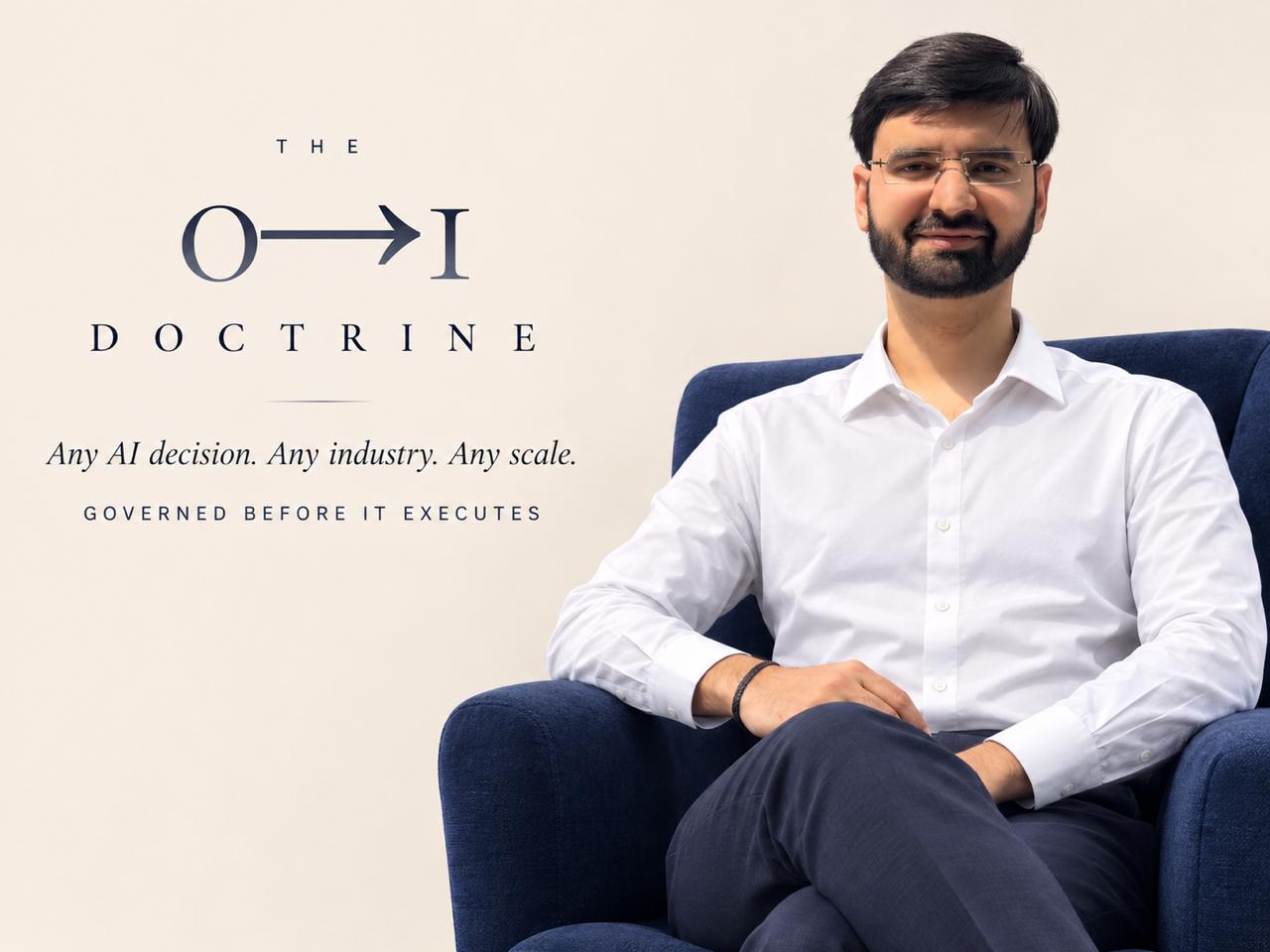

As AI moves from generating answers to taking consequential actions, the harder governance question is whether human-defined authority can remain enforceable before execution—even as AI advances toward the Singularity, quantum-era computing, AGI and ASI.
AI GOVERNANCE · PRE-EXECUTION · 0→1
THE QUESTION IS CHANGING
As AI agents move from answers to action, governance changes with them. An agent can search, compare, procure, route, price, schedule or trigger an external action without a person performing every step. The advantage is speed. The unresolved question is what establishes that an action fits its authorised boundary before it happens.
A DIFFERENT POINT OF CONTROL
The 0→1 Doctrine approaches that problem at the pre-execution boundary. It does not claim to make AI less capable or automate every decision. It separates capability from authority: a system may propose an action without thereby being authorised to execute it.
WHY 0 AND 1 MATTER
Classical binary computing uses 0 and 1 as discrete states; quantum computing uses 0 and 1 as basis states and can hold superposition before measurement. The Doctrine uses 0 and 1 differently: as endpoints of a continuous normalisation scale, bringing measurable values from different ranges into a common frame for comparison and governance.
FROM MEASUREMENT TO A BOUNDARY
A distance, probability, capacity limit, safety threshold or financial constraint can enter a 0-to-1 representation when meaningfully measurable. The values do not make unlike domains identical; they provide a common frame for defined conditions. A relevant signal is then tested against an authorised range before execution.
EXAMPLE — MANUFACTURING
A material-tolerance requirement band of [0.72, 0.79] can be compared with provider capability [0.69, 0.83]. Their overlap makes potential fit visible before production, alongside quality, process, energy and delivery conditions.
EXAMPLE — LOGISTICS
A developing disruption can be represented through carrier capability, handling quality, route reliability and delivery-time conditions. If bands overlap, a route may remain viable; if a safeguard is triggered, the action can continue, reroute or escalate. The value is preserving a decision before disruption becomes an executed failure.
EXAMPLE — AUTONOMOUS CAPITAL
For autonomous capital movement, allocation requirements can be compared with market or provider capability before execution. Compatibility evidence does not itself authorise the transaction. Mandatory controls and human approval remain decisive; a high result cannot turn an unresolved authority condition into permission.
EXAMPLE — CONSUMER PRODUCT
A consumer-product decision can compare functional fit, quality or defect fit, delivery fit and circularity or waste conditions. The aim is to identify mismatch before fulfilment, reducing returns, rework, cancellations and avoidable downstream cost.
THE HALLUCINATION TEST
AI-generated inputs can be tested before execution by applying defined bands to measurable conditions. The 0→1 Doctrine creates a structured pre-execution check, allowing governed systems to validate proposed values against authorised ranges before action proceeds.
THE MULTI-ACTION PROBLEM
Millions of individually acceptable actions could potentially produce an unacceptable aggregate result. A single-action boundary does not automatically solve path-dependent risk. It raises the next engineering question: whether governance should also consider sequence, shared state, cumulative exposure and coordinated agent behaviour.
AGENT SWARMS RAISE THE STAKES
Agentic systems may divide work among multiple systems: one sources, another negotiates, another schedules and another executes. The 0→1 approach treats consequential handoffs as governed conditions rather than assuming authority transfers automatically.
THE HARDWARE QUESTION
The 0→1 Doctrine does not depend on specific hardware. Secure deployments can also use trusted hardware to protect governance. High- and critical-risk systems can use Trusted Execution Environments and hardware attestation.
QUANTUM DOES NOT MAKE THE LOGIC DISAPPEAR
Quantum computing changes the computational and cryptographic environment, but not bounded numerical representation. The harder issue is preserving governance evidence as cryptographic assumptions evolve. The governance abstraction therefore needs to remain distinct from the computing substrate.
DELETE-BEFORE-SHARE
Delete-Before-Share applies the boundary principle to information. As infrastructure moves toward gigawatt-scale compute and zettabyte-scale data, the architecture proposes reducing information to what is needed for a lawful purpose, performing temporary calculations without retaining unnecessary raw data, and deleting it before onward sharing. The lawful owner retains control while the governed result moves.
BIOLOGICAL AGE
Calendar age shows why a common scale can help beyond computing. A person may be 55 years old by the calendar, while measurable indicators may suggest a biological profile closer to 48 or 62. A governed system could compare those indicators with a purpose-specific range, potentially informing healthier-life or added-life-year possibilities, without claiming an exact determination.
EARLY WARNING — PRECIOUS TIME
Natural-disaster response shows another use. Weather, seismic, satellite and infrastructure signals arrive with different scales and uncertainty. A governed representation can compare warning conditions with required action time, potentially preserving a period for evacuation or response. The objective is not perfect prediction, but earlier actionable decision-making.
WHAT IF AGI BECOMES SMARTER?
If governance had to understand every internal step of AGI’s reasoning, the problem would be enormous. The 0→1 approach is narrower: evaluate the proposed action and relevant measurable conditions. The intelligence may change without changing the authorisation boundary.
WHAT IF SUPERINTELLIGENCE PLAYS THE RULES?
Knowing a rule is not the same as possessing authority to change it. The difficult questions become who establishes the boundary, who may change it, which version applied and whether the execution record can be altered. This shifts part of the safety problem from model behaviour toward governance integrity.
WHAT WOULD ACTUALLY DISPROVE IT?
A serious architecture should be tested rather than praised. Can an unauthorised action pass? Can a parameter change between checking and execution? Can an agent influence its governing authority? Can permitted actions create an unacceptable aggregate outcome? Can a compromised environment bypass the control?
These are not assumed failures. They are the tests that determine where the architecture holds, where additional controls are required, and where its limits become visible.
THE SINGULARITY TEST
No responsible analysis can promise that one architecture will make future ASI incapable of defeating every conceivable control. The stronger question is whether human authority can remain separate from machine capability. If AI becomes faster, governance must operate at machine speed. If it becomes more autonomous, authority boundaries must become clearer.
THE CORE PROPOSITION
The 0→1 Doctrine does not need to claim that it solves AGI, ASI or the Singularity. Its central proposition is that capability and authority should be treated as different things: a measurable pre-execution boundary between what an intelligent system can propose and what it is authorised to cause.
*The future may not be decided by how intelligent machines become, but by whether humanity retains a meaningful, enforceable boundary between machine capability and authority to act.*
THE INVENTOR
Vatsal Soin is a serial inventor with patent filings across six continents, with grants in the US, India, Japan and South Africa. An alumnus of SIM–RMIT and Nanyang Technological University, Singapore, he received an August 14, 2026 grant for an AI-powered footwear and Global Sharable Size Card invention.
LIVE: www.0to1doctrine.com
This can be tested, live, via API, governed against ungoverned, side by side.
SELECTED REFERENCES
Granted: US Patent 12,446,652 B2 · Japan Patent 7560909 · India Patents 454081 and 599317 · Filed: PCT/IN2025/051943 · US 19/489,595 · India 202511115781 · Australia AU2022450649
DISCLAIMER: Informational only. Not certified. No endorsement implied. Not investment advice. Examples are illustrative, not field results. Vatsal Soin · © 2026 All Rights Reserved.
