
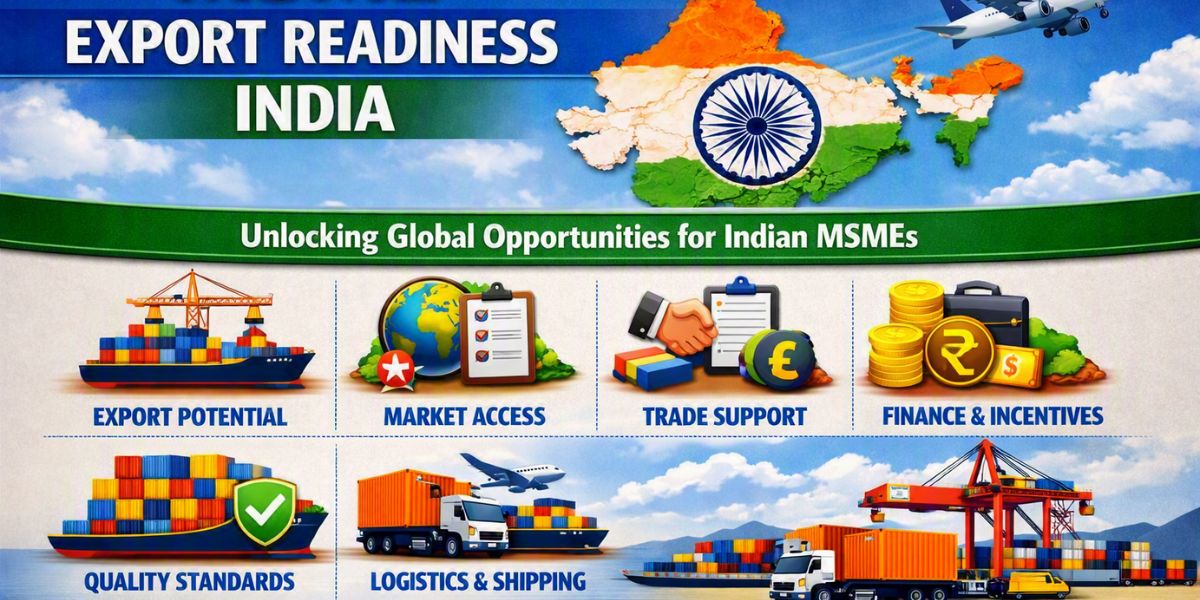

MSME export readiness in India has quietly become a more important question than the one everyone’s asking. The government has committed real money and real infrastructure to get small businesses exporting — a six-year, ₹25,060 crore Export Promotion Mission, fresh credit guarantees, interest subsidies, certification support.
The government-stated ambition is explicit: push India toward $2 trillion in total exports by 2030, with MSMEs carrying a growing share of that load. But scaffolding isn’t the same as readiness. For most small business owners, the honest question isn’t “does a scheme exist for me” — it’s “am I actually equipped to sell into a foreign market once I have the funding.”
This article looks past the scheme brochures and asks what “ready” really means for an Indian MSME in 2026 — and where the gap between policy intent and ground-level capability still sits.
Why the Government Is Pushing So Hard Right Now
The numbers explain the urgency. MSMEs already contribute close to 45% of India’s total exports while making up roughly 30% of GDP — a sector already punching above its weight without much dedicated export infrastructure behind it. The government’s read is straightforward: if a sector can do this much with minimal support, targeted support could unlock significantly more.
That’s the logic behind the Export Promotion Mission, approved by the Union Cabinet in late 2025 and now running through FY31. It isn’t a single scheme so much as an umbrella covering interest subvention on export credit, expanded collateral-free credit guarantees, certification support, and market-access programs.
Earlier export support was scattered across disconnected departments; this is the first attempt to bundle it under one mission. Momentum is already showing up in the trade data.
Engineering goods exports grew nearly 13% year-on-year in February 2026, and electronics exports rose over 10% in the same period. Agri-linked categories like meat, dairy, and poultry posted even sharper gains — on paper, a sector responding to support exactly as intended.
The Real Test of MSME Export Readiness in India
Here’s where the picture gets more complicated. Funding and credit access solve one problem — but they’re not the problem most first-time exporters actually run into first.
In practice, readiness breaks down into three harder categories that no scheme can fully hand to a business.
1. Certification and compliance, not capital
A manufacturer selling domestically has never had to prove much beyond basic quality control. A manufacturer trying to sell into the EU, US, or Gulf markets is walking into a wall of testing standards, product certifications, and documentation requirements that vary by market and by product category.
The government’s TRACE sub-scheme exists specifically to subsidize this cost — which is itself a signal of how real the barrier is. But subsidizing the certification cost doesn’t remove the time, expertise, or process overhaul most small manufacturers need to actually pass those certifications in the first place.
2. The working capital timing gap
Export cycles front-load cash outflow in a way domestic sales rarely do. Shipping, insurance, customs documentation, and compliance costs are paid well before a foreign buyer’s payment clears — often 60 to 90 days or more, depending on the market and payment terms negotiated.
This isn’t unlike the accrual-based cash flow squeeze many franchise-model businesses now face under GST 2.0’s invoicing rules — a mismatch between when money goes out and when it comes back in. The government’s interest subvention on export credit helps offset the cost of bridging that gap, but it assumes the business already has a credit relationship and a bank willing to extend it.
3. Market access and digital trade infrastructure
Even a certified, well-financed exporter still needs a buyer. Many MSMEs — especially outside established export clusters — simply don’t have the digital trade infrastructure, international payment systems, or buyer networks to find and close a foreign deal.
Government-facilitated trade fairs and buyer-seller meets help, but they reach a small fraction of the MSME base relative to how many businesses the schemes are theoretically open to.
The pattern that matters: most current schemes are built to reduce the cost of exporting once a business is export-ready. Very few are built to get a business to export-ready in the first place. That gap — not the availability of funding — is the real test of MSME export readiness in India right now.
A Complication the Schemes Weren’t Built For
Timing adds another layer of difficulty. Much of this export push is landing against a genuinely harder external environment than when the mission was first designed — tariff pressure on Indian exports to key markets, and geopolitical disruption in West Asia.
That disruption was significant enough that the government introduced a dedicated RELIEF scheme in March 2026 just to help exporters absorb the resulting cost shocks. None of this makes the underlying push wrong, but it does mean a first-time exporter today is stepping into more volatility than the original EPM design anticipated — worth factoring into any realistic timeline for returns.
Scheme Overload Is a Readiness Problem Too
One underrated barrier rarely gets discussed in policy coverage: the sheer number of schemes now available is, itself, an obstacle. Between the Export Promotion Mission, NIRYAT PROTSAHAN, the Credit Guarantee Scheme for Exporters, TRACE, RELIEF, and state-level programs like Haryana’s new MSME and Export Promotion Policy, a small business owner without a dedicated finance or compliance team has no simple way to know which scheme applies to their situation.
Awareness and navigability are functionally part of readiness. A scheme a business doesn’t know exists might as well not exist for that business.
What Actual Readiness Looks Like
Strip away the scheme names and a realistic export-readiness checklist for an Indian MSME looks like this:
- Valid Udyam registration and Importer Exporter Code (IEC) — the baseline eligibility for nearly every EPM sub-scheme, yet still a step many small businesses haven’t completed.
- Certification aligned to the target export market — not “compliance in general,” but the specific standard the destination market actually requires.
- A working capital runway that covers the pre-payment-to-collection gap — realistically modeled, not assumed away by available credit lines.
- An identified buyer or market, not just a product — schemes can subsidize outreach, but they can’t manufacture demand.
A business that can check all four boxes is genuinely positioned to benefit from what the government has built. A business that’s missing two or three of them is likely to find the schemes helpful but not sufficient — and that’s most MSMEs today, not a small minority.
Read: Top Highly Profitable Import Export Business Ideas
Where the Readiness Gap Is Smaller — and Where It Isn’t
The gap isn’t uniform across sectors. Engineering goods and electronics exporters tend to already operate closer to international quality benchmarks, since a share of their existing customer base often includes larger domestic OEMs with similar standards — the jump to export certification is smaller for them.
Agri-processing and marine products benefit from established export clusters and decades of institutional buyer relationships, which partly explains their stronger recent growth numbers. The gap widens most among first-generation manufacturers and smaller regional units with no prior export exposure at all.
These are exactly the businesses the Export Promotion Mission is theoretically designed to reach — and exactly the businesses least equipped to navigate it without direct hand-holding.
The Verdict
India hasn’t built more export infrastructure for MSMEs in the past eighteen months than in the prior decade by accident — the intent is genuine and the budget is real. But scaffolding around a business is not the same as the business being ready to climb it.
The MSMEs that actually benefit from this push over the next few years will be the ones that treat it as an execution problem — certification, cash-flow planning, market identification — rather than assuming funding access alone gets them across the finish line. For everyone else, the schemes will remain available, well-funded, and largely unused.
This article reflects India’s export policy landscape as it stood in August 2026. Scheme terms, budgets, and eligibility criteria are subject to change — verify current details on the official Export Promotion Mission and DGFT portals before applying.

We are a passionate and dedicated team of small business experts, committed to helping entrepreneurs and small business owners achieve their dreams. With a wealth of experience and a deep understanding of the unique challenges faced by small businesses, our mission is to provide new business ideas, actionable insights, and practical advice, to fuel your business growth.
