
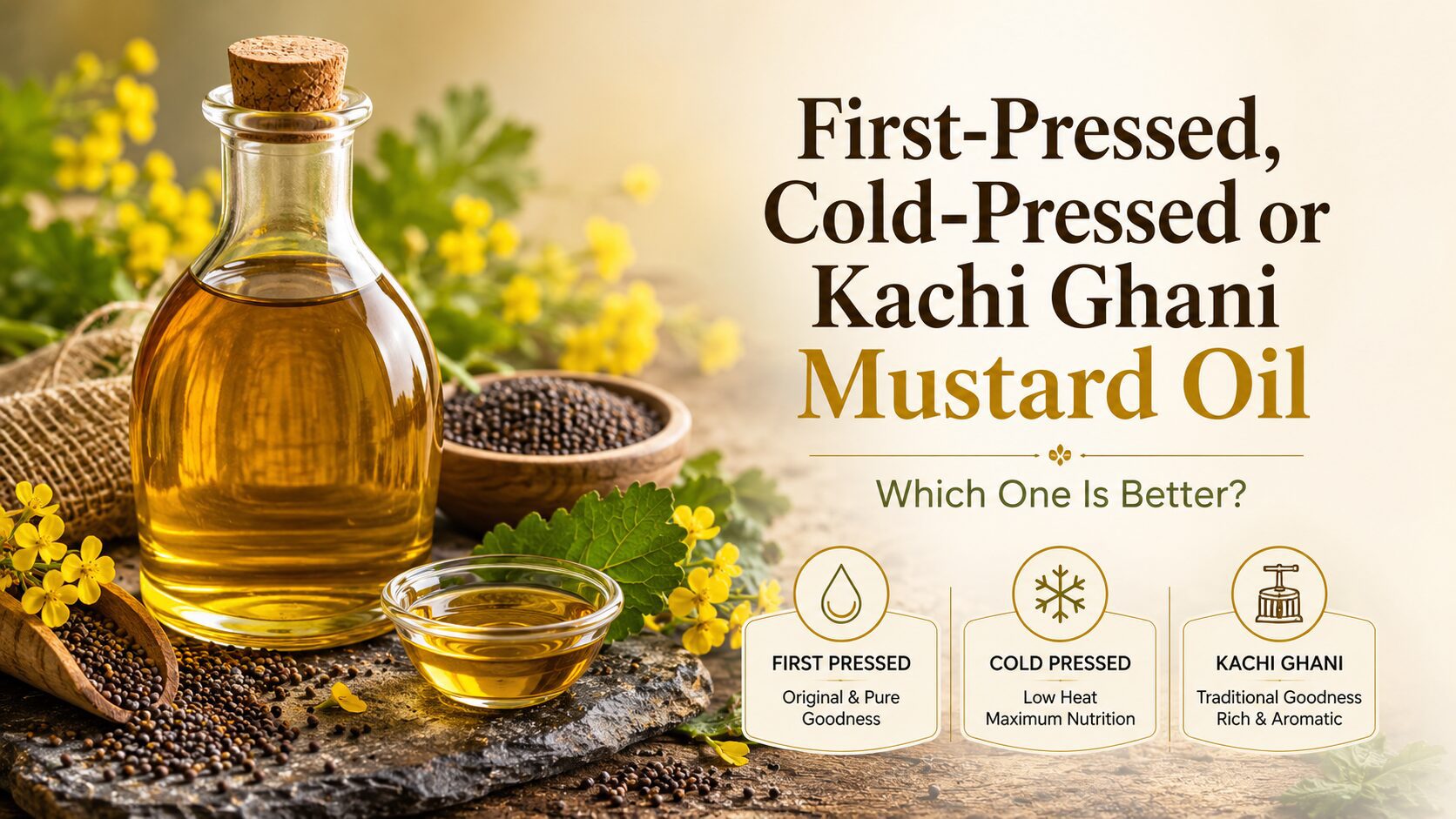

For generations, buying mustard oil in India was fairly simple. You looked for a strong aroma, a familiar pungency and a trusted brand or local source. Today, the shelf looks very different. Bottles are labelled first pressed, cold pressed, wood pressed, kachi ghani, unrefined and natural, often with little explanation of how these terms actually differ.
That has created a common question: Is first pressed mustard oil better than cold-pressed or regular kachi ghani mustard oil?
The answer becomes much easier once you stop treating these terms as three separate grades of oil. They actually describe different parts of the extraction process. “First pressed” refers mainly to the stage at which the oil is collected, while “cold pressed” describes the way oil is extracted. Kachi ghani, meanwhile, refers to a traditional Indian pressing method that is commonly used for mustard seeds.
This distinction matters because many people who are moving away from heavily refined cooking oils are now exploring traditionally extracted cold pressed oils for their stronger natural flavour and comparatively minimal processing. Mustard oil is one of the most familiar examples, but even within this category, the way the seeds are sourced and pressed can significantly influence the final product.
That is why choosing a cold pressed mustard oil should involve more than simply looking for one attractive word on the bottle. The quality of the mustard seeds, extraction process, level of refining and transparency of the manufacturer all matter.
So, what do first pressed, cold pressed and kachi ghani actually mean?
What Does First-Pressed Mustard Oil Mean?
The term first pressed mustard oil generally refers to oil collected during the initial pressing of mustard seeds.
Mustard seeds naturally contain oil. When they are mechanically crushed or pressed, that oil begins to separate from the seed material. The oil obtained during this first extraction may be described as first pressed.
The idea sounds simple, but the label alone does not tell the entire story.
For example, first pressed does not automatically mean that the oil was extracted at a low temperature. Nor does it necessarily mean that the finished oil was left unrefined.
In other words, “first pressed” tells you something about when the oil was collected, but not everything about how it was processed.
This is why the term is more useful when a manufacturer also provides information about its pressing temperature, refining process and mustard seed source.
A first-pressed oil that is also cold pressed and minimally processed gives the buyer considerably more information than a bottle that simply carries “first pressed” as a marketing claim.
What Is Cold-Pressed Mustard Oil?
Cold pressing describes the extraction process rather than the sequence of extraction.
In this method, mustard seeds are mechanically pressed while avoiding the intensive high-temperature treatment commonly associated with industrial oil refining.
The intention is to extract the oil more gently so that much of the seed’s natural aroma, flavour and character remain noticeable in the finished product.
This explains why traditional cold-pressed mustard oil usually has a distinctly sharp aroma and pungent taste.
For someone accustomed to neutral refined oils, that pungency can initially seem very strong. But in many Indian cuisines, it is exactly what makes mustard oil desirable.
It contributes flavour to pickles, marinades, curries, fish preparations, vegetables and several regional dishes where the oil is meant to be tasted rather than disappear into the background.
Cold pressing is also a much broader concept than mustard oil alone. Groundnut, sesame, coconut and other edible oils can also be produced using similar mechanical extraction methods.
Where Does Kachi Ghani Fit Into This?
Kachi ghani is where the terminology becomes slightly confusing because it overlaps closely with cold pressing.
Traditionally, a ghani or kolhu was used to slowly crush oilseeds and extract their oil through mechanical pressure. Mustard has been one of the seeds most commonly associated with this method in India.
That is why the phrase kachi ghani mustard oil has become almost synonymous with traditional mustard oil.
However, kachi ghani is better understood as a particular style of traditional pressing, while cold pressed is a broader description of oil extraction carried out without aggressive heating.
As a result, a genuine kachi ghani mustard oil may also be cold pressed.
This is an important distinction because consumers sometimes assume that they are choosing between “cold pressed” and “kachi ghani,” when the same bottle may technically fit both descriptions.
First Pressed vs Cold Pressed vs Kachi Ghani
The difference becomes much clearer when each term is looked at according to what it actually describes.
| Term | What It Describes | What It Tells You |
| First Pressed | Stage of extraction | Oil comes from the initial pressing |
| Cold Pressed | Extraction conditions | Oil is mechanically extracted with limited heat |
| Kachi Ghani | Traditional pressing method | Mustard seeds are slowly mechanically pressed |
The key point is that these are not mutually exclusive categories.
A mustard oil can be first pressed, cold pressed and kachi ghani at the same time.
So the real question is not simply, “Which label is better?”
It is: What does the complete production process look like?
Is First-Pressed Mustard Oil Better?
First pressed can certainly be a positive feature, particularly when the oil also comes from good-quality mustard seeds and is extracted using a gentle process.
But the phrase should not be treated as an automatic guarantee of superior quality.
Suppose one oil is advertised prominently as first pressed, but the manufacturer provides little information about temperature, refining or sourcing.
Another oil may be clearly described as cold pressed, unrefined and produced from carefully sourced mustard seeds, even though “first pressed” is not the main claim on the label.
It would be difficult to conclude that the first oil is automatically better.
The best mustard oil is better judged by the overall combination of seed quality, extraction, purity, processing and freshness.
What Are the Real Cold Pressed Mustard Oil Benefits?
There is no shortage of dramatic claims about cold pressed mustard oil benefits, especially online. Some go far beyond what a cooking oil can reasonably promise.
A more practical way to look at the benefits is through processing and culinary quality.
More of the Natural Mustard Character
Cold pressing helps preserve the characteristic aroma and pungency of mustard seeds.
For traditional Indian cooking, this can be one of the most noticeable differences between cold-pressed and heavily refined oil.
Minimal Processing
Many consumers choose cold-pressed oils because they want an oil that has undergone fewer intensive processing steps.
That makes the method particularly attractive to people looking for a more traditional or natural mustard oil.
Stronger Culinary Identity
Unlike a neutral cooking oil, mustard oil actively contributes to the flavour of a dish.
Its sharp character works especially well in:
- achar and pickles
- Bengali-style fish dishes
- marinades
- curries
- sabzis
- chutneys
- regional tadka preparations
This is also why judging mustard oil purely by how mild it tastes can be misleading. With traditionally produced mustard oil, a pronounced aroma is part of the product’s identity.
What Should You Look for When Buying Mustard Oil?
Once the terminology is clear, choosing an oil becomes much more straightforward.
Start with the ingredient list.
If you are looking for pure mustard oil, check whether mustard oil is the only oil listed or whether the product contains a blend.
Then look at how the manufacturer describes the extraction process. A transparent brand should be able to tell you more than simply “premium” or “natural.” Information about cold pressing, seed source and level of refining gives you something meaningful to evaluate.
The mustard seeds themselves also matter.
Different mustard varieties can produce oils with differences in pungency, colour and flavour. Seed quality, storage and freshness therefore influence the finished oil just as much as the pressing method.
Finally, consider what you actually want from the oil.
If your priority is an almost neutral cooking medium, a strongly aromatic cold-pressed mustard oil may not be what you are looking for.
If, however, you want the traditional mustard flavour used in Indian cooking, a pungent and minimally processed oil may be exactly the point.
Is Regular Kachi Ghani Still a Good Choice?
Yes, provided that it is genuinely produced using a suitable traditional pressing process and the oil is of good quality.
The growing popularity of phrases such as “first pressed” does not suddenly make regular kachi ghani mustard oil inferior.
In fact, kachi ghani mustard oil has been used in Indian households long before modern packaging began highlighting every stage of oil extraction.
A good kachi ghani oil can still offer the strong mustard flavour, aroma and traditional character that many consumers want.
The advantage of newer labels is simply that they can provide more information—if the manufacturer uses them transparently.
So, Which One Should You Choose?
If you find a mustard oil that is made from good-quality seeds, extracted slowly at controlled temperatures, minimally processed and obtained from the first pressing, that combination certainly sounds appealing.
But there is no need to treat “first pressed” as a completely separate category sitting above cold pressed or kachi ghani.
The better approach is to think of these terms as pieces of the same puzzle.
First pressed tells you about the extraction stage.
Cold pressed tells you about the extraction conditions.
Kachi ghani tells you about the traditional method used to press the mustard seeds.
The strongest product may incorporate more than one of these characteristics.
The Bottom Line
So, is first-pressed mustard oil better than cold-pressed or regular kachi ghani?
Not automatically.
A first-pressed oil can be an excellent choice, but its quality still depends on the mustard seeds, extraction temperature, purity and subsequent processing. Likewise, a well-produced kachi ghani mustard oil can also be cold pressed and minimally processed.
Rather than choosing the bottle with the most impressive terminology, look for a producer that clearly explains where the mustard comes from, how it is pressed and what happens to the oil afterwards.
That will tell you far more about the quality of your mustard oil than any single phrase printed on the front of the bottle.
