
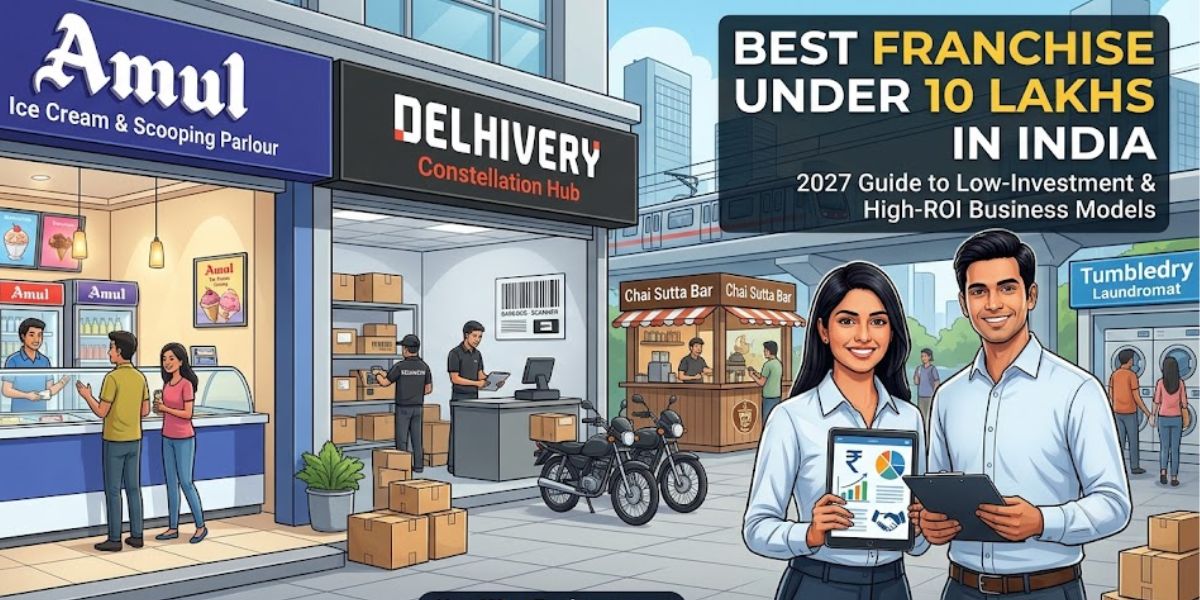

Launching a business through a franchise model remains one of the safest pathways to entrepreneurship in India. By acquiring a recognised brand, an established supply chain, and proven operational blueprints, investors minimise the high failure rates associated with starting from scratch. Driven by rising disposable income, expanding D2C logistics, and growing consumer reliance on branded services across Tier-1, Tier-2, and Tier-3 cities, opening a franchise under 10 lakhs in India has become a primary target for first-time business owners, MSME investors, and corporate professionals seeking recurring revenue.
However, many prospective franchisees fall into the “₹10 Lakh Capital Trap.” A common mistake is confusing the upfront Franchise Fee with the Total Capital Expenditure (CapEx). An opportunity marketed with a ₹5 Lakh franchise fee often requires an additional ₹6 Lakhs for shop fit-outs, inventory, IT equipment, security deposits, and working capital reserves—pushing the true investment well past ₹11 Lakhs. A sustainable ₹10 Lakh budget must account for all-in setup costs plus at least 60 to 90 days of operational runway.
This comprehensive 2027 guide evaluates the top franchises in India under ₹10 Lakhs total CapEx, providing verified financial parameters, space requirements, unit economics, and strategic risk breakdowns.
Top 10 Franchises Under 10 Lakhs — Directory Overview
Compare the leading low-investment franchise opportunities in India across key business metrics:
|
Brand Name |
Industry Sector |
Est. Total Setup CapEx |
Required Floor Space |
|---|---|---|---|
|
Amul Ice Cream / Scooping Parlour |
F&B / Dairy Retail |
₹3 Lakhs – ₹6 Lakhs |
150 – 300 sq ft |
|
Delhivery (Constellation Hub) |
Logistics & E-Commerce Delivery |
₹3 Lakhs – ₹8 Lakhs |
400 – 1,000 sq ft |
|
Chai Sutta Bar (Kiosk Format) |
QSR / Beverage Kiosk |
₹6 Lakhs – ₹9.5 Lakhs |
100 – 250 sq ft |
|
Dr. Lal PathLabs (Collection Centre) |
Healthcare & Diagnostics |
₹3 Lakhs – ₹5.5 Lakhs |
150 – 300 sq ft |
|
One Bite (QSR Outlet) |
Fast Food / QSR |
₹7 Lakhs – ₹9.5 Lakhs |
200 – 400 sq ft |
|
DTDC Express (Retail Counter) |
Courier & Express Cargo |
₹1 Lakh – ₹3.5 Lakhs |
100 – 300 sq ft |
|
Thyrocare (Diagnostic Collection) |
Health & Wellness |
₹2 Lakhs – ₹4.5 Lakhs |
100 – 200 sq ft |
|
The Belgian Waffle Xpress (TBWX) |
Dessert & QSR Kiosk |
₹5 Lakhs – ₹8.5 Lakhs |
100 – 200 sq ft |
|
Tumbledry (Laundromat / Dry Cleaning) |
Consumer Services |
₹8 Lakhs – ₹10 Lakhs |
250 – 500 sq ft |
|
InXpress (Asset-Light Shipping) |
B2B Freight Brokerage |
₹9 Lakhs + GST |
Work-from-Home / Office |
🔍 Filter Live Franchise Listings Under ₹10 Lakhs
Want to filter verified business opportunities by your target city, category, and exact capital? Explore active opportunities in our directory.
Category 1: Food & Beverage (F&B) and Dessert Kiosks
1. Amul Ice Cream Parlour / Scooping Centre
Operated by the Gujarat Cooperative Milk Marketing Federation (GCMMF), Amul is widely considered one of India’s safest low-cost retail franchises due to unmatched brand recall and zero ongoing royalty payments.
- Estimated Total Investment: ₹3 Lakhs – ₹6 Lakhs (Includes non-refundable brand guarantee, equipment, refrigeration, and interior decoration).
- Space Required: 150 – 300 sq ft (High footfall market, main road, or residential cluster).
- Margin & Profit Model: Franchisees earn ~20% on pre-packed ice creams, ~50% on recipe-based scooping sundaes, and ~25% on dairy products.
- Best For: First-time investors seeking a steady, low-risk business in Tier-1 to Tier-4 locations.
Strategic Advantage: Amul charges 0% royalty and zero revenue commission. Every rupee of profit made above store operational expenses stays with the owner.
Operational Risk to Watch: Strict power backup requirements. Commercial ice cream freezers require uninterrupted power supplies; a prolonged outage without a generator or inverter backup can ruin inventory.
2. Chai Sutta Bar (Kiosk / Mini Cafe)
Chai Sutta Bar has expanded rapidly across India by converting traditional tea stalls into clean, Westernised kulhad tea hubs that appeal to college students and office workers.
- Estimated Total Investment: ₹6 Lakhs – ₹9.5 Lakhs (Covers franchise fee, kitchen equipment, kulhad stock, signage, and POS system).
- Space Required: 100 – 250 sq ft.
- Margin & Profit Model: High gross margins (50%–60%) on tea and pocket-friendly snacks like burgers, fries, and grilled sandwiches.
- Best For: University areas, commercial IT parks, and youth-centric markets.
Strategic Advantage: High daily transaction volume. Kulhad tea generates rapid cash turnarounds and high repeat customer metrics.
Operational Risk to Watch: High staff attrition in the QSR industry. Reliance on trained kitchen staff means sudden turnover can interrupt daily operations if the owner isn’t hands-on.
3. One Bite (QSR Fast Food Outlet)
One Bite is a rapidly growing quick-service restaurant (QSR) network with over 400 locations across India, specialising in burgers, pizzas, wraps, waffles, and beverages.
- Estimated Total Investment: ₹7 Lakhs – ₹9.5 Lakhs (Covers franchise fee, complete kitchen equipment package, initial raw stock, and store design).
- Space Required: 200 – 400 sq ft.
- Margin & Profit Model: Expected net profit margins range between 25% and 35% with zero ongoing monthly royalty.
- Best For: Semi-urban markets and non-metro district headquarters with limited branded western fast-food alternatives.
Strategic Advantage: Complete kitchen hardware setup (pizza ovens, deep fryers, dough kneaders, contact grillers) provided upfront by the franchisor.
Operational Risk to Watch: Food wastage management. Perishable inventory must be carefully controlled using point-of-sale forecasting tools to prevent inventory write-offs.
4. The Belgian Waffle Xpress (TBWX)
Speciality dessert counters represent a fast-growing, high-margin category in urban markets, characterised by low staff requirements and simplified preparation.
- Estimated Total Investment: ₹5 Lakhs – ₹8.5 Lakhs.
- Space Required: 100 – 200 sq ft (Malls, high-street markets, or food courts).
- Margin & Profit Model: Gross margins on waffle batter and toppings can reach up to 65%–70%.
- Best For: High-density urban retail belts, food courts, and metro stations.
Strategic Advantage: Minimal kitchen footprint and low workforce dependencies. A small kiosk can be operated efficiently by just 1 or 2 staff members.
Operational Risk to Watch: Highly sensitive to footfall quality. A low-traffic location will struggle to cover fixed rental costs due to reliance on impulse purchases.
Category 2: Logistics, Delivery & Express Cargo Hubs
5. Delhivery (Constellation Partner Hub)
Delhivery is India’s largest fully integrated independent logistics platform, enabling local partners to manage exclusive last-mile delivery territories under its Constellation Partner Program.
- Estimated Total Investment: ₹3 Lakhs – ₹8 Lakhs (Includes security deposit, sorting tables, barcode scanners, CCTV installation, initial rider onboarding, and working capital).
- Space Required: 400 – 1,000 sq ft (Ground floor facility with accessible loading bays).
- Margin & Profit Model: Fixed payout per successful doorstep delivery (₹14 – ₹32 based on weight, geography, and terrain), plus RTO return pickup fees.
- Best For: High-density residential zones, Tier-2 cities, and industrial clusters.
Strategic Advantage: Guaranteed daily parcel flow. E-commerce partners receive automated shipment feeds without spending on customer acquisition or marketing.
Operational Risk to Watch: Delivery executive retention. Managing 4 to 12 delivery riders is required; high turnover can cause undelivered parcel backlogs and contractual SLA penalties.
6. DTDC Express (Retail Booking Counter)
DTDC stands as one of India’s most recognised express courier brands, offering low-capex retail booking outlets across 12,000+ franchisee locations nationwide.
- Estimated Total Investment: ₹1 Lakh – ₹3.5 Lakhs (Flex/Smile sub-franchise model) | ₹3.5 Lakhs – ₹6.5 Lakhs (Full DTDC360 Store).
- Space Required: 100 – 300 sq ft.
- Margin & Profit Model: Franchisees retain approximately 75%–80% of booking collections, paying the rest as carrier fees. Net profit margins range from 20% to 35%.
- Best For: Commercial markets, legal office complexes, and trade centres.
Strategic Advantage: Asset-light model. Outbound booking counters accept shipments from customers; the central DTDC network handles long-haul transport and final delivery without requiring franchisee-owned vehicles.
Operational Risk to Watch: Volumetric weight miscalculations. Incorrectly measuring or weighing parcels at the counter can trigger carrier debit notes that erode profit margins.
7. InXpress (B2B Freight & Logistics Consulting)
InXpress offers a unique, asset-light B2B shipping franchise model where partners act as logistics consultants for small and medium-sized enterprises (SMEs).
- Estimated Total Investment: ₹9 Lakhs + GST (Franchise fee and initial operational license).
- Space Required: No commercial store required (Can operate from a home office).
- Margin & Profit Model: ~30% gross margin split on discounted shipping volumes resold to corporate clients via carrier partners like DHL and FedEx.
- Best For: Experienced B2B sales professionals, corporate executives, and trade consultants.
Strategic Advantage: Zero physical inventory, zero fleet management, and zero warehouse rent. Extremely scalable business model with recurring corporate revenue.
Operational Risk to Watch: Requires active B2B sales outreach. Success relies on prospecting local manufacturers, exporters, and merchants rather than relying on walk-in retail traffic.
Category 3: Healthcare, Diagnostics & Consumer Services
8. Dr Lal PathLabs (Patient Service Centre)
Diagnostic collection centres of Dr Lal PathLabs represent a non-cyclical, service-driven business model backed by India’s expanding private healthcare and preventative diagnostic market.
- Estimated Total Investment: ₹3 Lakhs – ₹5.5 Lakhs (Covers franchise fee, phlebotomy setup, centrifuge, refrigeration, branding, and IT connectivity).
- Space Required: 150 – 300 sq ft (Ground floor with bathroom facility and patient waiting area).
- Margin & Profit Model: Franchisees earn 25% – 35% commission on total diagnostic billings; parent labs process the actual blood and tissue samples.
- Best For: Doctor-dense clinic zones, hospital roads, and residential neighbourhoods.
Strategic Advantage: Non-discretionary demand. Healthcare testing remains resilient regardless of economic downturns.
Operational Risk to Watch: Phlebotomist dependency. You must hire qualified, certified phlebotomists; sample contamination or poor blood drawing technique damages reputation quickly.
9. Thyrocare (Aarogyam Collection Centre)
Thyrocare specialises in low-cost preventative health checkup packages and automated pathology testing across India.
- Estimated Total Investment: ₹2 Lakhs – ₹4.5 Lakhs.
- Space Required: 100 – 200 sq ft.
- Margin & Profit Model: Flat commission rate on blood test bookings and specialised wellness packages (e.g., Aarogyam profiles).
- Best For: Semi-urban towns and suburban residential markets.
Strategic Advantage: Extremely low capital outlay and standardised digital booking infrastructure.
Operational Risk to Watch: Cold-chain sample logistics. Drawn samples must be stored within strict temperature ranges before regional pickup, requiring reliable refrigeration.
10. Tumbledry (Laundromat & Dry Cleaning)
Tumbledry is India’s largest laundry and dry cleaning network, tapping into urbanisation, busy double-income households, and rising demand for professional garment care.
- Estimated Total Investment: ₹8 Lakhs – ₹10 Lakhs (Covers commercial washers, dryers, dry cleaning equipment, chemical kits, and store decor).
- Space Required: 250 – 500 sq ft.
- Margin & Profit Model: High gross margins (55%–65%) on dry cleaning, shoes, and specialised leather care services.
- Best For: High-density urban residential apartments, tech corridors, and metro suburbs.
Strategic Advantage: Recurring monthly subscription-style customer usage pattern paired with high average order value on delicate clothes.
Operational Risk to Watch: Commercial utility demands. High water consumption and electrical loads demand appropriate commercial utility approvals before lease execution.
How to Allocate a ₹10 Lakh Franchise Budget
To avoid running out of liquidity before reaching profitability, use this operational CapEx and OpEx framework when deploying your capital:
|
Expense Category |
Recommended Budget Allocation |
Target Amount (out of ₹10 Lakhs) |
Purpose / Deliverables |
|---|---|---|---|
|
Franchise Fee |
20% – 30% |
₹2,00,000 – ₹3,00,000 |
Brand rights, initial training, technology platform access |
|
Fit-Out & Store Interior |
30% – 40% |
₹3,00,000 – ₹4,00,000 |
Signage, interior decor, counters, lighting, seating, flooring |
|
Equipment & IT Infrastructure |
20% – 25% |
₹2,00,000 – ₹2,50,000 |
Refrigerators, ovens, POS systems, CCTV, barcode scales |
|
Initial Stock / Raw Material |
10% – 15% |
₹1,00,000 – ₹1,50,000 |
Foundational inventory, packaging items, branded uniforms |
|
Working Capital Reserve |
10% – 15% |
₹1,00,000 – ₹1,50,000 |
3-month buffer for rent, utility bills, and staff salaries |
Red Flags to Avoid When Buying a Sub-₹10 Lakh Franchise
- Undisclosed Mandatory Supply Markup: Some franchisors offer “Zero Royalty” options, but require you to buy all ingredients or stock exclusively from them at inflated prices, eroding your gross margin. Always inspect the mandatory purchase agreement.
- Lack of Pin-Code Territory Protection: Ensure the franchise contract defines an exclusive geographical radius (e.g., 2 km or a specific pin code) to prevent the franchisor from opening another outlet near yours.
- Exaggerated Break-Even Promises: Be sceptical of sales pitches claiming full payback within 3 to 4 months. Realistically, brick-and-mortar retail and service franchises take 6 to 18 months to break even.
- Omission of Working Capital in Pitch Decks: Always calculate rent, electricity tariffs, and staff payroll for at least 90 days independently. Do not assume immediate positive cash flow from Day 1.
Frequently Asked Questions (FAQs)
What is the most profitable franchise under 10 lakhs in India?
Profitability depends on your operational involvement and location. Non-royalty F&B models like Amul Ice Cream (high margins on scooping), high-volume Chai Sutta Bar outlets, and Delhivery last-mile hubs (in high parcel density zones) consistently deliver strong net profits relative to capital deployed.
Can I get a bank loan (e.g., MUDRA or PMEGP) for a franchise under 10 lakhs?
Yes. Government-backed loan schemes like Pradhan Mantri MUDRA Yojana (Tarun category up to ₹10 Lakhs) and MSME collateral-free loans can be applied toward franchise ventures, provided you submit a viable business plan, franchisor agreement, and projected financial statements.
How much monthly profit can I expect from a 10 lakh investment?
A well-managed franchise with a total investment of ₹10 Lakhs typically generates a net monthly profit ranging between ₹30,000 and ₹90,000 after accounting for rent, employee salaries, royalties, utilities, and raw materials, reflecting an average ROI of 15% to 30% annually.
Is a courier or delivery franchise better than an F&B franchise under 10 lakhs?
It depends on your background. Delivery hubs (like Delhivery or Valmo) and courier counters (like DTDC) are B2B-focused, operational logistics businesses with zero food wastage and predictable demand. F&B franchises yield higher gross margins per item but require managing food shelf-life, staff churn, and local hygiene compliance.
Disclaimer: Investment metrics, space requirements, and financial estimates listed in this guide are derived from market benchmarks and publicly available data. Actual financial performance, territory availability, and commercial terms are subject to formal agreement between the franchisee and the respective franchisor.

We are a passionate and dedicated team of small business experts, committed to helping entrepreneurs and small business owners achieve their dreams. With a wealth of experience and a deep understanding of the unique challenges faced by small businesses, our mission is to provide new business ideas, actionable insights, and practical advice, to fuel your business growth.
