


India has 580 million people between the ages of 5 and 24. Its education market is valued at over $117 billion and growing at 13–15 per cent annually. And yet, most articles about education franchises in India tell you the same thing — a list of brand names, a vague investment range, and the phrase “high ROI” repeated until it loses all meaning.
This article is different. We have organised the best education franchise in India by category, because a preschool investor, a coaching centre investor, and a skill-development investor have completely different investment thresholds, operational requirements, and customer demographics. Comparing them in a single flat list without context does not help you make a decision.
Every franchise below includes an honest investment range, a realistic net margin, the ideal investor profile, and the one risk that most articles about that franchise skip.
How to Use This Guide
India’s education franchise market breaks into six distinct categories. Each has a different investment level, different customers, different seasonality, and a different profitability model. The most important decision you will make is not which brand to choose — it is which category fits your location, your capital, and your operating style.
- Preschool / Early Childhood: Investment range of ₹8–30 lakhs; targets ages 2–6 in residential areas and young family neighbourhoods.
- K-12 Supplementary Tutoring: Investment range of ₹2–15 lakhs; targets ages 6–18 near schools and residential areas across all city tiers.
- Competitive Exam Coaching: Investment range of ₹30 lakhs–₹1 crore+; targets ages 16–24 in cities with large student populations.
- Skill Development / Vocational: Investment range of ₹5–20 lakhs; targets ages 18–35 near colleges, IT corridors, and employment hubs.
- Coding / Robotics / STEM: Investment range of ₹5–15 lakhs; targets ages 6–16 in Tier-1 and Tier-2 cities with tech-aware parents.
- Abacus / Mental Math / Speciality: Investment range of ₹50,000–₹3 lakhs; targets ages 5–14 across all city tiers with home-based options.
Best Preschool Franchises in India
India’s preschool market is projected to reach $11 billion by 2033, growing at 9.5 per cent CAGR. Only 2 per cent of India’s 165 million children aged 0–6 are currently enrolled in formal preschools — compared to 90 per cent plus in developed countries. That gap is the opportunity. Preschool franchises are recession-resistant, demand is genuinely undersupplied in Tier-2 and Tier-3 cities, and parent spending on early childhood education continues to rise regardless of economic cycles.
What no article tells you about preschool franchises: The admission cycle is annual and highly seasonal — most enrollments happen between January and April. This means your revenue is heavily front-loaded in the first 4 months of the year, and you need adequate working capital to cover June through December, when admissions are slow and fees are collected in instalments. Any preschool franchise investor who does not plan their cash flow around this cycle will face liquidity stress even in a profitable centre.
1. Kidzee
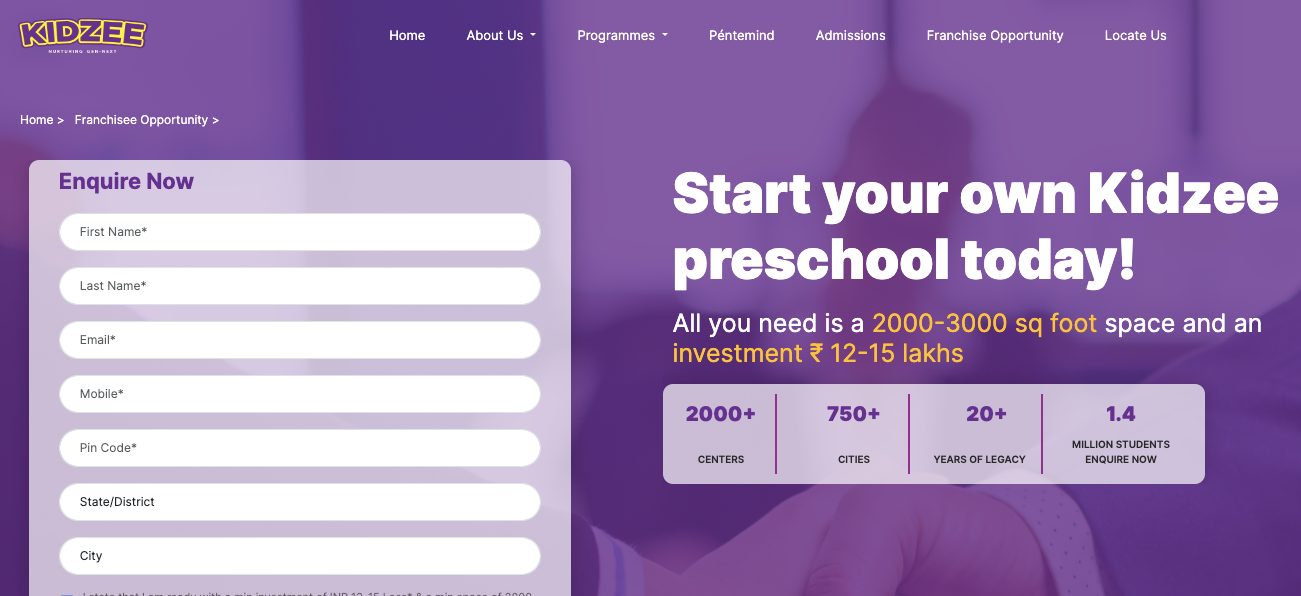
- Parent Company: Zee Learn Limited (listed on BSE/NSE)
- Founded: 2003
- Network: 1,900+ centres across India — Asia’s largest preschool chain
- Investment: ₹12–20 lakhs (total including setup and working capital)
- Space Required: 2,000–3,000 sq ft — ground floor preferred, with outdoor play area
- Royalty: 15–20 per cent of monthly fee collection
- Break-even: 2–3 years (enrolment-dependent)
- Monthly Net Income (60 students): ₹40,000–₹80,000 after royalty, staff, and rent
- Best For: Residential areas in Tier-1 and Tier-2 cities with young family demographics
Why it works: Kidzee’s brand recognition among parents is unmatched in the preschool category. Its Play-Way pedagogy is well-documented, and the 1,900+ centre network means operational issues have been solved at scale. The Zee Learn parent company provides institutional stability.
The risk most articles skip: The 15–20 per cent royalty is levied on fee collection — not on profit. In a centre with 40 students at an average fee of ₹2,500/month, that is ₹10,000–₹12,500 going to the franchisor before you pay rent or staff. Kidzee centres in saturated urban markets — where every residential colony already has 2–3 preschools — struggle with both enrollment and pricing pressure simultaneously.
2. EuroKids
- Parent Company: Lighthouse Learning (formerly EuroKids International)
- Founded: 2001
- Network: 1,200+ centres across India; presence in Nepal and the UAE
- Investment: ₹15–20 lakhs (total)
- Space Required: 1,500–2,000 sq ft with outdoor play area
- Royalty: ~15 per cent of the monthly fee collection
- Break-even: 18–30 months
- Monthly Net Income (70 students): ₹50,000–₹1,00,000
- Best For: Upmarket residential areas; parents seeking premium international-curriculum preschool
Why it works: EuroKids positions at a slight premium over Kidzee — its EUNOIA curriculum backed by 35,000+ hours of research gives it credibility with aspirational urban parents. The brand consistently ranks among India’s most trusted in the TRA Brand Trust Report. Monthly fees can be 20–30 per cent higher than comparable Kidzee centres, improving absolute revenue per student.
The risk most articles skip: Space requirements (1,500–2,000 sq ft) combined with the need for a ground-floor location with an outdoor play area in a good residential neighbourhood means finding and affording the right premises is the hardest part of opening a EuroKids centre. In high-rent urban markets, the property cost alone can push your break-even to 3+ years.
3. Bachpan Play School
- Parent Company: S.K. Educations Pvt. Ltd.
- Founded: 2004 — Rewari, Haryana
- Network: 2,000+ centres — one of the largest preschool networks in India
- Investment: ₹8–15 lakhs (total)
- Space Required: 1,500–2,000 sq ft
- Royalty: ~10–15 percent of the monthly fee collection
- Break-even: 18–24 months
- Best For: Tier-2 and Tier-3 cities — particularly strong in North India; lower investment than Kidzee/EuroKids
Why it works: Bachpan is the go-to preschool franchise for Tier-2 and Tier-3 markets. Lower investment, lower royalty, and strong network recognition outside metros. Over 2,000 centres demonstrate system viability. Particularly strong in North and Central India, where the brand has been building recognition since 2004.
The risk most articles skip: Brand recognition is significantly weaker in South India and metro markets. If you are in a Tier-1 city competing with Kidzee and EuroKids, Bachpan’s lower fee positioning can work against you in neighbourhoods where parents associate price with quality.
Best K-12 Tutoring and Supplementary Education Franchises
The K-12 supplementary education segment is the most accessible entry point in education franchising — investments start as low as ₹2 lakhs, and the demand is consistent year-round because academic pressure on Indian students begins in Class 1 and does not let up until Board exams. Unlike preschools, these centres are not as affected by the annual enrollment cycle — students join throughout the year as academic pressure builds.
What no article tells you: The biggest challenge in K-12 tutoring franchises is teacher quality and retention. The franchise gives you the brand, curriculum, and systems — but if your centre’s teachers are inconsistent or leave mid-year, parent churn is immediate, and word-of-mouth damage in a residential catchment spreads fast. Every successful K-12 tutoring centre owner has solved the teacher problem first.
4. BYJU’S Tuition Centre (BTC)
- Parent Company: Think & Learn Pvt. Ltd. (BYJU’S)
- Network: 500+ Tuition Centres across India
- Investment: ₹20–40 lakhs
- Space Required: 1,500–3,000 sq ft
- Target Students: Class 4–12 — Math, Science, English across boards (CBSE, ICSE, State)
- USP: Tablet-based personalised learning; BYJU’S content library; hybrid model
- Best For: Tier-1 and Tier-2 cities; tech-aware parents who value personalised learning
Why it works: BYJU’S brand recognition is near-universal in India’s urban middle class. The tech-enabled teaching model differentiates BTC centres from generic tuition shops. The content library is genuinely good and continuously updated.
The risk most articles skip: BYJU’S as a company has gone through severe financial turbulence — including insolvency proceedings and management upheaval. Before investing in a BTC franchise, verify the current operational status of the tuition centre programme and the support infrastructure directly with the company. The brand equity is still strong with students, but the franchisor’s financial situation introduces uncertainty that no other K-12 franchise carries at this scale.
5. Kumon India
- Parent Company: Kumon Institute of Education (Japan) — 60+ years old, 4 million students globally
- Network: 400+ centres in India
- Investment: ₹3–8 lakhs (among the most affordable structured tutoring franchises)
- Space Required: 400–800 sq ft — can operate from home or community space
- Royalty: Per-student monthly fee to Kumon
- Target Students: Age 3–18 — Math and English programmes using the self-paced worksheet method
- Best For: Former teachers, education-background investors, home-based operators
Why it works: Kumon’s self-paced worksheet methodology is genuinely differentiated from classroom coaching. Students progress at their own pace, reducing the dependency on teacher quality. The global brand gives Indian parents institutional confidence. Low space requirement makes it viable as a home-based or community-centre business.
The risk most articles skip: Kumon is a slow-burn business. Student progress is incremental, and parent results take 6–12 months to become visible. Centres that close within 18 months almost always do so because the franchisee expected faster revenue growth than the Kumon model delivers. It is an excellent long-term business — but requires patient capital and strong parent communication skills.
Best Competitive Exam Coaching Franchises in India
Competitive exam coaching is India’s highest-revenue education category — the NEET and JEE coaching market alone is valued at over ₹58,000 crore. The demand is structural: every year, 2.5 million students appear for NEET and 1.5 million for JEE, and the vast majority require coaching. The Indian test preparation market is anticipated to reach approximately USD 6.04 billion. However, this is also the highest-investment, highest-risk category in education franchising. Faculty quality determines everything — a centre that loses its top teacher loses its top students.
What no article tells you: The competitive exam coaching market has a dangerous pattern of result inflation. Many coaching centres — including franchise ones — advertise “500 selections in NEET” without disclosing how many students enrolled or what percentage passed. Before investing, ask the franchisor for their selection rate — selections divided by total enrolled students — not the raw selection number. A centre with 50 selections from 60 students is far stronger than one with 500 selections from 10,000 students.
6. Aakash Institute (AESL)
- Parent Company: Aakash Educational Services Limited — subsidiary of Think & Learn (BYJU’S)
- Founded: 1988 — New Delhi
- Network: 300+ centres across India
- Investment: ₹30–70 lakhs
- Space Required: 3,000–8,000 sq ft — multiple classrooms required
- Target Students: Class 8–12 and droppers — NEET, JEE, NTSE, Olympiads, Foundations
- Revenue Model: Annual course fees of ₹80,000–₹1,50,000 per student
- Break-even: 2–3 years (requires a minimum of 150–200 students for consistent profitability)
- Best For: Cities with large Class 10–12 population, investors with ₹50+ lakhs capital and prior education sector exposure
Why it works: Aakash’s 36-year brand history, centralised academic delivery model, and documented results make it India’s most credible exam coaching brand for franchising. High course fees per student mean fewer enrollments are needed to achieve strong revenue. The National Academic Team handles curriculum, reducing local faculty dependency.
The risk most articles skip: Aakash is connected to ownership structures that have undergone insolvency and restructuring proceedings. While Aakash has operated independently and profitably, there is management uncertainty and possible strategic shifts that prospective franchisees must investigate directly before committing ₹30–70 lakhs. Additionally, in cities where Allen Career Institute or Sri Chaitanya already has a dominant presence, Aakash franchisees face a very hard competitive battle.
7. PhysicsWallah (PW Vidyapeeth)
- Founded: 2020 (offline centres); originally a YouTube channel from 2014
- Network: 100+ Vidyapeeth and Pathshala centres — rapidly expanding
- Investment: ₹80 lakhs–₹1 crore+ (Vidyapeeth full centre)
- Space Required: 4,000–10,000 sq ft
- Target Students: Class 11–12, droppers — JEE and NEET focus; Class 6–10 foundations
- Revenue Model: Course fees positioned 30–40 per cent below Aakash and Allen — “affordable quality” brand promise
- Best For: Tier-2 and Tier-3 cities where Aakash/Allen are absent or expensive; investors with a strong education background
Why it works: PhysicsWallah has an 18-million-subscriber YouTube following and a genuine cult following among Class 11–12 students. Its affordable pricing model captures the large student population that cannot afford Aakash or Allen but wants quality beyond local coaching. The brand’s digital-first origin gives it natural reach in smaller cities where Aakash has no physical presence.
The risk most articles skip: PW Vidyapeeth is a young franchise system — less than 5 years old in the offline format. The operational support infrastructure for franchisees is still maturing compared to the 36-year-old Aakash. The ₹1 crore investment at a nascent stage in franchise system development is a risk that deserves careful due diligence. Ask to speak with existing Vidyapeeth franchisees before signing.
8. Career Launcher
- Founded: 1995 — New Delhi
- Network: 175+ centres across India
- Investment: ₹30–50 lakhs
- Target Students: Graduates and working professionals — CAT, CLAT, CUET, IPMAT, BBA, design entrance
- USP: Post-graduate and management entrance — less competition from Aakash/Allen
- Best For: University towns and cities with a large graduate population, and investors wanting the management exam segment
Why it works: Career Launcher occupies a distinct niche — management, law, and design entrance — that is completely separate from the Aakash/Allen/PW battle for NEET/JEE students. CAT and CLAT coaching carry high per-student fees (₹40,000–₹1,20,000 per course), and the student demographic is older, more independent, and less price-sensitive. It is a less crowded competitive environment than medical/engineering coaching.
Best Skill Development and Vocational Training Franchises
India’s skill development gap is well-documented — the National Skill Development Corporation estimates 400 million people need to be skilled or upskilled to meet industry demand. The government’s Skill India Mission and the private sector’s AI-driven demand for tech-literate workers have created a genuine structural opportunity in vocational training. Unlike preschool or coaching franchises, skill development centres serve working adults — meaning evening and weekend operations are viable, reducing the need for premium commercial space during business hours.
9. NIIT
- Founded: 1981 — New Delhi (India’s oldest IT training company)
- Network: 500+ centres in India; global presence in 40+ countries
- Investment: ₹10–20 lakhs
- Space Required: 1,000–2,000 sq ft with computer lab
- Target Students: Students and working professionals — IT, programming, data analytics, AI/ML, digital marketing
- Royalty: Variable — based on revenue sharing model
- Break-even: 18–30 months
- Best For: Cities with engineering college presence, IT corridors, and working professional population
Why it works: NIIT’s 44-year brand history is unrivalled in Indian IT training. Corporate tie-ups for employee training provide B2B revenue that stabilises the business beyond individual student enrollments. Industry-recognised certifications carry genuine employment value with Indian IT companies.
The risk most articles skip: NIIT faces serious competition from free and low-cost online platforms — Coursera, Udemy, and YouTube have eroded demand for in-person basic IT training. NIIT centres that have survived and thrived have pivoted to high-ticket advanced programmes (Data Science, AI, Cloud, Cybersecurity) and B2B corporate training. If you plan to run an NIIT centre selling basic programming courses, you are fighting a structural headwind. Verify the current course portfolio and its local market demand before investing.
10. Aptech
- Founded: 1986 — Mumbai
- Network: 800+ centres across India and 40+ countries
- Investment: ₹8–15 lakhs
- Space Required: 800–1,500 sq ft
- Target Students: Students and graduates — multimedia, animation, web development, aviation, hospitality, hardware
- Best For: Cities with creative industries, IT companies, hospitality sector; diversified course portfolio reduces risk
Why it works: Aptech’s diversified course portfolio — spanning IT, animation, aviation, and hospitality — gives it multiple revenue streams that NIIT’s pure IT focus does not have. Aviation and hospitality training carry premium fees and face less free online competition than basic IT courses. The 800+ centre network signals strong market penetration.
Best Coding and STEM Franchises in India
India’s coding education market for children is growing at over 25 per cent annually — driven by National Education Policy 2020’s emphasis on coding from Class 6, parental awareness of AI’s impact on future employment, and the genuine shortage of quality coding teachers in schools. This is the fastest-growing new category in education franchising. It is also the youngest in terms of brand maturity — most franchises in this space are less than 10 years old, which means higher growth potential but less proven system stability.
11. Mastermind Abacus and STEM Brands
- Investment: ₹5–12 lakhs for coding/robotics centres
- Space Required: 400–1,000 sq ft — can operate from existing school premises
- Target Students: Age 6–16
- Revenue Model: Monthly subscription fees of ₹1,500–₹4,000 per student
- Best For: Areas near CBSE schools; tech-aware parent demographic
What to look for in coding franchises: The coding franchise market in India is crowded with new entrants, many of whom lack curriculum depth. Before investing, evaluate the franchise on three criteria: (1) Is the curriculum updated annually to reflect real industry tools — Python, Scratch, AI basics — or is it teaching outdated frameworks? (2) Does the franchise have a formal school partnership programme that gives your centre direct access to students? (3) What is the teacher certification programme — can you maintain quality if your primary coding teacher leaves?
Best Low-Investment Education Franchises (Under ₹3 Lakhs)
Not every education investor has ₹20–50 lakhs to deploy. The low-investment segment — abacus, Vedic maths, handwriting, spoken English — allows entry from ₹50,000 and can generate meaningful supplementary income, especially for teachers, homemakers, and first-time business owners.
12. Abacus Franchise (SIP Abacus, Mastermind, G-Champ)
- Investment: ₹50,000–₹3 lakhs (depending on brand and format)
- Space Required: Home, community hall, or small classroom — no dedicated commercial space needed
- Target Students: Age 5–14
- Revenue Model: Monthly fees of ₹800–₹1,500 per student; 25–40 students typical for a home centre
- Monthly Net Income (30 students): ₹15,000–₹35,000 — excellent supplementary income, not a full-time replacement
- Best For: Teachers, homemakers, working professionals, adding supplementary income; Tier-2 and Tier-3 towns; all of India
Why it works: Abacus training has genuine cognitive development benefits — improved concentration, memory, and mental calculation — that parents value independently of academic results. The low investment, home-based model, and pan-India demand make it one of the most accessible business opportunities in India. SIP Abacus has over 35,000 centres in India alone — the proven market demand is not in question.
The honest limitation: Abacus is supplementary income — not a full-time business for most operators. A 30-student home centre at ₹1,200/month generates ₹36,000 gross — after franchise fee, materials, and small overhead, net income is ₹20,000–₹28,000/month. That is excellent for a teacher running it from home with minimal cost. It is insufficient if you have rented a commercial space and hired staff.
13. Spoken English / Language Franchises (Speakwell, British Lingua)
- Investment: ₹1–5 lakhs
- Target Students: Age 15–35 — students, job seekers, working professionals
- Monthly Fees: ₹1,500–₹4,000 per student per course
- Best For: Tier-2 and Tier-3 cities where the English proficiency gap is great and employment-linked demand is strong
Why it works: English communication skills are increasingly tied to employment outcomes — from call centre jobs to corporate careers to international opportunities. In Tier-2 and Tier-3 cities, the gap between English demand and quality supply is wide. Low investment, no lab equipment needed, and relatively easy teacher hiring make this one of the cleanest low-investment education businesses available.
The Education Franchise Selection Framework — How to Choose the Right One
After reviewing every major franchise category, here is the decision framework that matters more than any brand name:
|
Your Financial & Operating Situation |
Best Category |
Best Starting Brand Examples |
|---|---|---|
|
₹5–15 lakhs, residential area, family neighbourhood |
Preschool |
Bachpan (Tier-2/3) or EuroKids (Tier-1) |
|
₹2–8 lakhs, near schools, former teacher |
K-12 tutoring |
Kumon |
|
₹30–70 lakhs, city with large student population, education background |
Competitive coaching |
Aakash (NEET/JEE) or Career Launcher |
|
₹80 lakhs–₹1 crore, Tier-2 city, no Aakash/Allen presence |
Competitive coaching |
PhysicsWallah Vidyapeeth |
|
₹10–20 lakhs, near colleges or IT offices |
Skill development |
NIIT (advanced courses only) or Aptech |
|
₹50,000–₹2 lakhs, homemaker or teacher, any location |
Abacus / specialty |
SIP Abacus, G-Champ, or Mastermind |
|
₹3–10 lakhs, Tier-2/3, near CBSE schools |
Coding / STEM |
Regional and national STEM networks |
The 5 Questions to Ask Any Education Franchisor Before Signing
- What is your selection rate — not selection count? Franchisors in the coaching space advertise raw selection numbers. Ask for selections divided by enrolled students. A 40 per cent selection rate is meaningful. A 5 per cent selection rate on 10,000 students is marketing, not performance.
- How many franchisees have closed in the last 3 years? Every healthy franchise system has some closures — it is the ratio that matters. More than 10–15 per cent in 3 years is a warning sign about system viability, support quality, or market saturation.
- What happens if my head teacher leaves? In coaching and tutoring franchises, the best teacher is often the primary reason students enrol. Ask the franchisor how they support franchisees through teacher turnover — do they have a teacher placement network, or are you on your own?
- Is the royalty on gross revenue or net profit? The answer completely changes your profitability model. Royalty on gross revenue (the more common structure) is paid regardless of your margin. On a thin-margin month, a 15–20 per cent royalty on gross fees can eliminate your entire net profit.
- Can I speak with 5 existing franchisees — including 2 who have been operating for less than 2 years? Long-tenured franchisees who are doing well are easy to find. Ask for recent franchisees who are still in the ramp-up phase. Their experience reflects the current state of franchisor support, not the support quality from 5 years ago.
Education Franchise — Key Market Statistics
|
Metric |
Data Point |
|---|---|
|
India education market size |
$117+ billion |
|
CAGR of India education market |
13–15 per cent annually |
|
India’s youth population (age 5–24) |
580 million |
|
NEET applicants annually |
2.5 million+ |
|
JEE applicants annually |
1.5 million+ |
|
Preschool enrollment rate (India) |
~2 percent of eligible 0–6 age group |
|
Preschool enrollment rate (developed countries) |
90 percent+ |
|
India’s skill development gap (NSDC estimate) |
400 million people need upskilling |
|
NEET/JEE coaching market value |
₹58,000 crore+ |
Frequently Asked Questions
Which is the best education franchise in India for low investment?
For investment under ₹3 lakhs, abacus and Vedic maths franchises — such as SIP Abacus, G-Champ, and Mastermind Abacus — offer the lowest entry cost starting from ₹50,000 with consistent demand across all city tiers. For investment between ₹3–10 lakhs, Kumon and spoken English franchises offer strong, structured models. The right choice depends on whether you want supplementary income or a full-time education business.
Which education franchise in India has the highest ROI?
Competitive exam coaching franchises — Aakash, PhysicsWallah, and Career Launcher — offer the highest potential ROI due to high per-student fees. However, they also require the highest investment (₹30 lakhs–₹1 crore), the longest break-even timeline (2–3 years), and the most demanding operational model. For investors who want high ROI with lower risk and investment, well-located preschool franchises in underserved Tier-2 cities consistently deliver strong returns over a 3–5 year horizon.
Can I start an education franchise in India from home?
Yes — abacus, Vedic maths, spoken English, and some coding franchises are specifically designed for home-based or community-space operation. Kumon also allows smaller-format home centres. These home-based models typically generate ₹15,000–₹35,000 monthly net income with 25–40 students, making them strong supplementary income sources for teachers, homemakers, and part-time operators.
Is an education franchise recession-proof?
Education is one of the most recession-resistant business categories in India — Indian families consistently prioritise education spending even during economic downturns. However, “recession-proof” does not mean “competition-proof.” A preschool in a saturated urban colony will struggle regardless of the market cycle. The category is resilient; the individual location and brand still determine your success.
What is the typical break-even period for an education franchise in India?
Break-even periods vary significantly by category and investment level. Abacus and low-investment franchises can break even in 6–12 months. Preschool franchises typically break even in 18–30 months. K-12 tutoring centres break even in 12–24 months. Competitive coaching centres have the longest break-even — 24–36 months — reflecting the higher initial investment and the time needed to build a reputation for results in the local market.
Which education franchise in India is best for Tier-2 and Tier-3 cities?
Tier-2 and Tier-3 cities represent the strongest growth opportunity in Indian education franchising. Bachpan Play School, Kumon, SIP Abacus, PhysicsWallah Vidyapeeth, and spoken English centres consistently perform well in smaller cities. The key advantage: lower rent, less brand competition, and a large student population that has limited access to quality education.
Disclaimer: Investment figures, market data, and franchise details in this article are based on publicly available information. Actual investment requirements, royalty structures, and ROI figures vary by location, franchisor policy, and market conditions. Always conduct independent due diligence and verify all current terms directly with the respective franchisor before making any investment decision. NextWhatBusiness does not receive commission from any franchise brand mentioned in this article.

Jayashree Mukherjee | Business Strategist & Franchise Analyst.
Jayashree is a management professional dedicated to helping entrepreneurs find their “next what” in business. From analysing franchise opportunities to drafting solopreneur roadmaps, she provides the data-driven insights founders need to move from idea to execution.
Editorial oversight is provided by Rupak Chakrabarty, Editor, NextWhatBusiness.
