
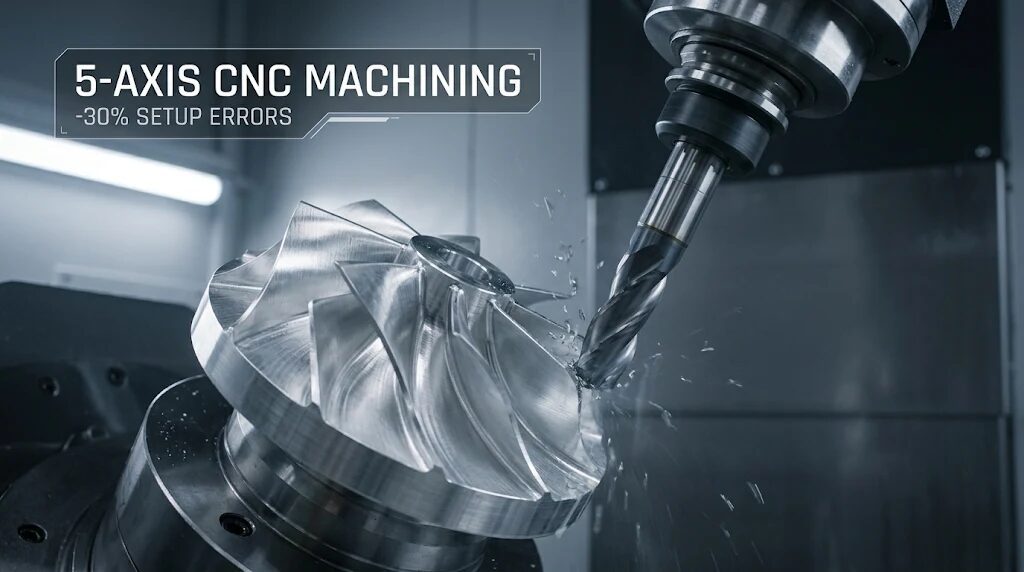

Simultaneous 5-axis impeller machining maintains optimal tool angles in a single setup, reducing dimensional errors by 30% on thin-walled blades.
More than 30% of all dimensional errors and scrap on impellers and other complex parts occur due to multiple setups with repeated clamping that result in a cumulative chain of shifts in the datum. 5 axis CNC machining service completely removes this chain of error.
Why Does Traditional 3-Axis Machining Struggle with Complex Contours?
Traditional 3-axis machines only move along linear X, Y, and Z axes. If machining deep cavities, angle holes or undercuts you’ll need to break the cycle and re-fixture the part several times.
Datum Shifts from Multiple Setups
Each re-clamping requires manual dial-indicator alignment. Even a 0.01 mm setup deviation multiplies across subsequent operations, ruining true position tolerances between features on different faces.
Tool Deflection and Chatter
Comparing 5-axis vs 3-axis advantages exposes a significant tooling restriction. Cutting tools with long reaches must be used on a 3-axis machine to access deep pockets without running into spindle. Cutting overhangs of 3-axis tools are related to a loss of tool stability and resulting high-frequency vibrations that impact surface finish and compromises multi-axis CNC tolerances.
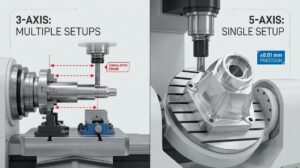 Comparison of 5-axis vs 3-axis setups: Single-setup 5-axis machining eliminates cumulative datum shifts and holds multi-axis CNC tolerances within ±0.01 mm.
How Does Simultaneous 5-Axis Technology Solve Impeller Machining Challenges?
Impeller blades are twisted and thin walled, with small flow channels that cannot be machined cleanly on a standard 3-axis machine.
Dynamic Tool Vector Control
In 5-axis impeller machining,rotary axes constantly orient the work piece or spindle to ensure the proper lead angle of tools and avoid clash with other blades.
Balanced Cutting Loads on Thin Walls
Executing Custom Complex 5 Axis Machining keeps chip loads constant along curved surfaces. It reduces radial cutting forces, prevents deflection of the thin walls, and ensures smooth finishes (Ra < 0.8 µm) without hand polishing.
How Can Aluminum 5-Axis Machining Balance Speed and Surface Quality?
Lightweight designs rely on aluminum alloys like 6061-T6 and 7075-T6, requiring targeted strategies to cut cycle times without losing accuracy.
Shorter Tooling for Higher Feed Rates: Tilting the work table allows the machinists to utilize shorter tooling, allowing high speed and feed rates which reduce the cycle time by up to 40%.
Stress Relief and Tolerance Control: Pre-stressed stock and single setup finishing prevent any deformation. The custom aluminum 5-axis CNC service utilizes tolerances between ±0.01 mm and ±0.1 mm.
How Should Buyers Evaluate and Source Reliable Online 5-Axis Quotes?
Partner selection will determine how well advanced CAD design concepts can be translated into metal parts.
Validating 5-Axis Machining Capacity
Procurement managers need to separate 3+2 axis positioning from true 5-axis contour machining using Rotational Tool Center Point (RTCP). Moreover, good suppliers always offer DFM checks to identify problematic thin walls or narrow radii prior to the part machining process.
Streamlining Digital RFQ Workflows
When requesting an online quote CNC machining service, engineers should upload native 3D STEP files alongside 2D PDF drawings specifying critical geometric tolerances and surface finishes. Your engineering team can buy CNC machined parts online from our digital fabrication shop with no hidden lead times and complete design for manufacturing validation in real time.
How Does 5-Axis Machining Bridge Prototyping to Volume Production?
Transitioning a complex part from prototype to batch production can often be held back by fixture redesign and inconsistent implementation.
CAM Program and Fixture Standardization
The cutting parameters, fixtures, and toolpaths once proved for the prototypes are used exactly the same for batch productions without any redesigns of the set-ups.
Process Control Under ISO 9001 Standards
Strict governance ensures repeatability. Partnering with an ISO 9001-certified manufacturer like JS Precision locks in automated tool monitoring and standardized workflows, guaranteeing every batch of custom 5-axis cnc machining parts maintains identical accuracy across repeat orders.
Conclusion
Simultaneous 5-axis CNC machining removes the 30% error rate tied to multi-setup fixturing, allowing for higher surface finishes for impellers and difficult-to-machinize aluminum parts and faster production times. Matching the ideal multi-axis kinematic with set process control locks hardware projects out of costly rework.
If your engineering team is preparing complex prototypes or production batches, submit your 3D CAD files to JS Precision for a comprehensive DFM review and rapid machining quote.
Author Bio
Doris Wu works at JS Precision, focusing on rapid prototyping to volume production across custom CNC machining, precision sheet metal, and injection molding. She specializes in tight tolerance control and DFM optimization for complex custom parts.
FAQs
- What is the main difference between 3+2 axis and simultaneous 5-axis machining?
3+2 machining is used to hold the rotary axes during cut so step marks are left on the curved surface. Simultaneous 5-axis enables all 5 axes to work together to keep the best possible tools angles resulting in the parts surface being smooth.
- Which industrial parts benefit most from 5-axis CNC machining?
Fluid impellers, aerospace brackets, robotic housings, medical components, and multi-ported manifolds benefit most from custom complex 5 axis machining due to their deep cavities and undercuts.
- What tolerances can aluminum 5-axis CNC parts reliably achieve?
An aluminum 5-axis CNC service can ensure linear tolerances from 0.01 mm to 0.1 mm and optimal true-position accuracy through single setup finishing.
- What files are required for an accurate 5-axis online quote?
For an online quote CNC machining service, submit a 3D CAD model (STEP or IGES) plus a 2D PDF drawing specifying tolerances, materials, and surface finishes.
- Why does ISO 9001 certification matter when sourcing complex CNC parts?
ISO 9001 indicates that a supplier adheres to documented quality processes that include traceability to raw materials and calibrated machinery, ensuring minimal dimensional variation for batch production.
Add Business Connect magazine to your Google News feed
