


Key takeaways
- DOGE fell 25.3% in November through Thursday’s close, after a 20% drop in October, erasing roughly 40% of its value since the end of September.
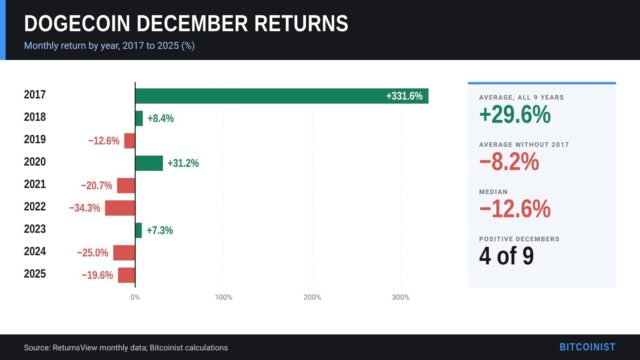
- December’s 29.6% average return (2017-2025) is skewed by 2017’s 331.6% gain; without it the average is about -8.2%, and the median is -12.6%.
- DOGE finished December higher in only four of nine years.
- Of five negative Novembers since 2017, four were followed by further December losses; 2018 was the exception (+8.4%).
- After a 25.3% fall DOGE needs about 34% to get back to its November starting price, and about 67% to undo October and November together.
The Dogecoin price is heading into the final days of November with nearly a quarter of its value wiped out since the start of the month. Historical returns suggest December could offer some relief, but a closer look at the numbers reveals why investors should be careful about betting on a year-end recovery.
According to monthly market data from ReturnsView, DOGE was down 25.3% in November through Thursday’s close, following a 20% decline in October. Together, the two months have erased roughly 40% of Dogecoin’s value since the end of September.
December’s historical performance looks considerably more encouraging. The problem is that one exceptional year accounts for much of that optimism.
Dogecoin’s Bullish December Average Hides An Uncomfortable Truth
Between 2017 and 2025, Dogecoin recorded an average December return of approximately 29.6%. At first glance, that makes the final month of the year look like a particularly attractive period for buyers.
In reality, DOGE finished December higher in only four of those nine years.
December 2017 is largely responsible for the impressive average. Dogecoin gained 331.6% that month, during one of the most speculative periods in the cryptocurrency market’s early history.
Take that single observation out of the calculation and Dogecoin’s average December return falls to negative 8.2%.
The median return, which is less sensitive to extraordinary rallies, stands at negative 12.6% across the full nine-year sample.
Removing 2017 does not mean another exceptional rally is impossible. It simply illustrates how little the headline average tells investors about what a more typical December has looked like.
What Happens To Dogecoin After A Losing November?
There is another historical pattern worth examining, particularly given the extent of DOGE’s losses this month.
Bitcoinist’s December 2025 analysis of Dogecoin’s seasonal performance identified a tendency for negative November returns to carry over into the following month. The completed results from last year provide another observation to test that pattern.
Since 2017, Dogecoin has recorded five negative Novembers. Four were followed by further losses in December.
In 2021, DOGE lost 23.3% in November before falling another 20.7% in December. The following year was even more punishing, with December losses reaching 34.3% after a negative November.
Last year followed a similar course. Dogecoin declined 21.7% in November 2025 and lost another 19.6% in December.
There was, however, an exception. In 2018, DOGE recovered by 8.4% in December despite losing 42.5% the previous month.
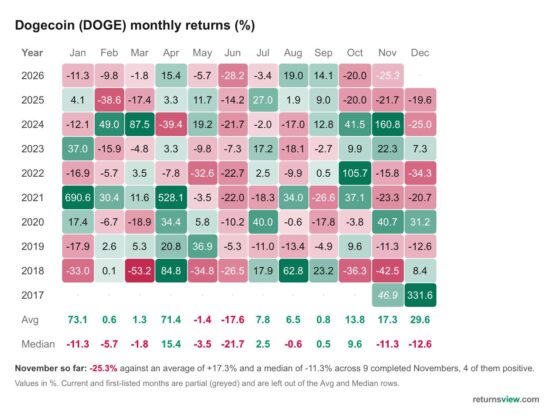
Five observations are nowhere near enough to establish a dependable trading rule. Still, the historical record offers little evidence that a particularly bad November makes a December recovery inevitable.
What Would A December Recovery Actually Look Like?
The scale of Dogecoin’s recent decline creates a mathematical problem for investors hoping to recover their losses before the end of the year.
A 25.3% decline requires a subsequent gain of almost 34% just to return to the starting price.
Recovering the combined losses from October and November would require a considerably larger move of approximately 67%, assuming November ends near Thursday’s level.
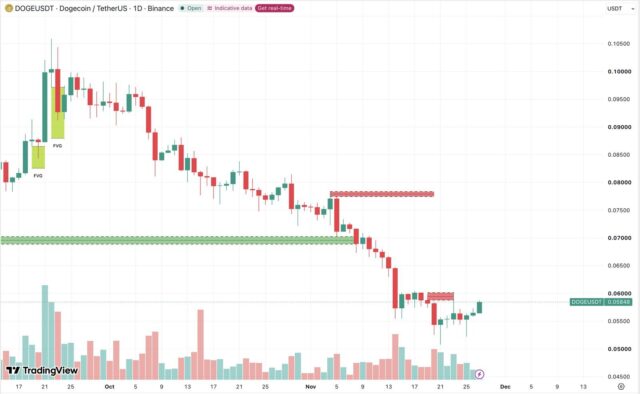
Investors tracking Dogecoin’s price and market performance should pay particular attention to whether a December rebound is accompanied by sustained spot buying and stronger trading activity, rather than relying on historical returns alone.
Dogecoin has produced extraordinary rallies before, and its volatility makes a sharp recovery entirely possible. But December’s reputation as a profitable month owes much to a market environment that existed nine years ago.
The calendar is about to change. Whether demand for DOGE changes with it is a different question.
Editorial Process for bitcoinist is centered on delivering thoroughly researched, accurate, and unbiased content. We uphold strict sourcing standards, and each page undergoes diligent review by our team of top technology experts and seasoned editors. This process ensures the integrity, relevance, and value of our content for our readers.
