

Cricket history is filled with extraordinary players who dominated opponents, broke records and delivered unforgettable performances. However, individual excellence does not always translate into team success, and several legendary cricketers ended their careers without winning the ICC Men’s ODI World Cup. Despite their remarkable contributions to the sport, the ultimate prize in 50-over cricket remained out of reach.
Some came incredibly close to achieving their dream. Sourav Ganguly guided India to the 2003 final, Kumar Sangakkara featured in two consecutive World Cup finals, and Brian Lara experienced the heartbreak of a narrow semi-final defeat in 1996. They built exceptional careers but never lifted the coveted trophy.
10 legendary cricketers who never won the men’s ODI World Cup
1. Brian Lara (West Indies)

Brian Lara‘s name remains synonymous with batting excellence. The former West Indies captain combined graceful stroke play with an exceptional ability to dismantle bowling attacks, finishing his ODI career with 10,405 runs. His closest opportunity to claim a World Cup title arrived in 1996. West Indies appeared well placed in their semi-final against Australia before an unexpected batting collapse turned the contest around. The Caribbean team eventually suffered a heartbreaking five-run defeat.
Lara participated in four other editions of the tournament, but the West Indies never secured the trophy during his international career. Despite his individual achievements, a World Cup triumph remained missing from his collection.
2. Jacques Kallis (South Africa)

Jacques Kallis was an outstanding all-rounder whose contributions with both bat and ball made him indispensable to South Africa. He accumulated 11,579 ODI runs and took 273 wickets, establishing himself among the most accomplished players of his generation.
South Africa reached the semi-finals of the 1999 and 2007 World Cups while Kallis was part of the team. However, neither campaign resulted in an appearance in the final. His remarkable consistency across two disciplines made him one of cricket’s most complete performers. Nevertheless, despite his numerous individual milestones, an ODI World Cup medal remained beyond his reach.
3. Sourav Ganguly (India)

Ganguly left a lasting influence on Indian cricket, particularly through his leadership. As captain, he encouraged a more confident and competitive approach, helping India develop into a formidable opponent both at home and overseas. His finest World Cup campaign came in 2003, when India advanced to the final under his leadership. Ganguly produced several important performances during the tournament, including three centuries, as India enjoyed an impressive run.
However, Australia proved too strong in the final in Johannesburg, defeating India to claim the championship. Ganguly retired before India’s historic triumph in 2011, meaning the former captain never became an ODI world champion.
4. Rahul Dravid (India)

Widely known as ‘The Wall’, Rahul Dravid built his reputation on discipline, sound technique and an ability to handle pressure. He scored 10,889 runs in ODI cricket and consistently provided stability to India’s batting order. Dravid featured in three World Cup editions: 1999, 2003 and 2007. India’s journey in 2003 ended with a defeat against Australia in the final, while the other campaigns failed to deliver the desired result.
His adaptability and dependable batting made him one of India’s most valuable players across formats. Yet, despite his substantial contribution to the national side, the ODI World Cup title remained absent from his list of achievements.
5. Kumar Sangakkara (Sri Lanka)

Sangakkara was a prolific left-handed batter and an accomplished wicketkeeper who played a central role in Sri Lanka’s success during his career. He finished with 14,234 ODI runs, placing him among the format’s most successful run-scorers. Sangakkara experienced the disappointment of losing two World Cup finals. Sri Lanka went down against Australia in 2007 before suffering another final defeat against India in 2011.
His final World Cup appearance in 2015 was particularly remarkable. Sangakkara scored four consecutive centuries during the group stage, producing one of the most memorable individual batting achievements in the tournament’s history. Despite his consistency and longevity, the ODI World Cup trophy ultimately eluded him.
Also READ: Aaron Finch names the greatest player of current decade
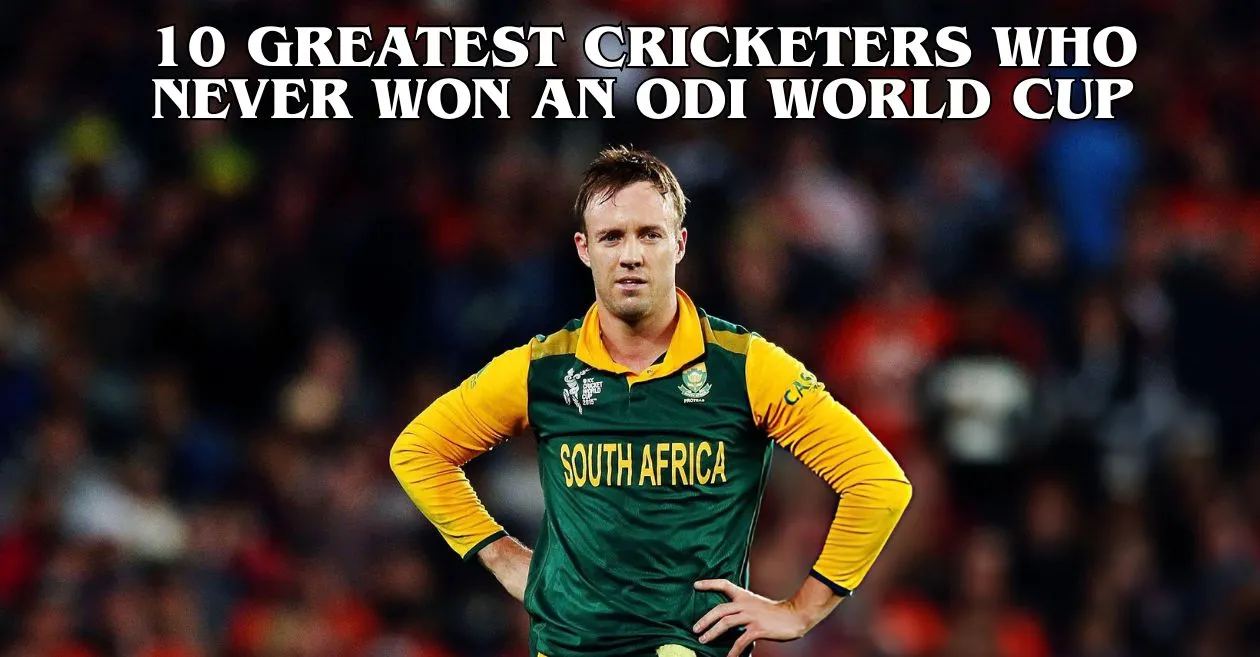
6. AB de Villiers (South Africa)

Proteas superstar AB de Villiers redefined attacking batting through his creativity, versatility and ability to find scoring opportunities in almost every area of the ground. His aggressive approach made him one of the most entertaining players in modern ODI cricket.
He accumulated 9,577 runs at an average of 53.50, underlining his extraordinary consistency alongside his ability to score at a rapid pace. South Africa reached the semi-finals in 2007 and 2015 during his career. The 2015 campaign ended in especially painful circumstances when New Zealand defeated the Proteas in a dramatic semi-final.
De Villiers achieved numerous personal milestones and established himself as one of the greatest ODI batters, but he retired without winning cricket’s biggest 50-over tournament.
7. Graham Gooch (England)

Graham Gooch was a prominent figure in English cricket during the 1980s and early 1990s. His batting ability, experience and leadership helped him become one of England’s most influential players. Gooch appeared in three World Cup finals, representing England in 1979, 1987 and 1992. England lost to the West Indies in the first, Australia in the second and Pakistan in the third.
One of his finest performances came during the 1987 semi-final against India, when he scored a century to help England reach the championship match. However, Australia prevailed in the final, denying him the opportunity to lift the trophy. Despite reaching the final three times, Gooch finished his career without an ODI World Cup victory.
8. Martin Crowe (New Zealand)

Martin Crowe was among New Zealand’s finest batters and played an important role in shaping the team’s approach to limited-overs cricket. His most memorable World Cup campaign came in 1992, when he captained New Zealand to the semi-finals. Crowe amassed 456 runs during the tournament and received the Player of the Tournament award for his outstanding batting performances.
New Zealand’s impressive journey ended against Pakistan in the semi-final. Pakistan subsequently went on to win the championship, leaving Crowe and his teammates disappointed. His tactical awareness, batting excellence and influence on the game ensured a lasting legacy, even though he never experienced the triumph of becoming a world champion.
9. Allan Donald (South Africa)

Known as ‘White Lightning’, Allan Donald was one of the most intimidating fast bowlers of his era. His combination of speed, aggression and accuracy made him a formidable opponent for batters around the world. Donald became a key figure in South African cricket following the country’s return to international competition. Throughout the 1990s, he established himself as one of the leading pace bowlers in the ODI format.
South Africa enjoyed several strong World Cup campaigns during his career but repeatedly fell short at crucial stages. The team reached the semi-finals in 1992 and 1999, yet Donald retired without winning the tournament. His contribution to South Africa’s rise as a competitive international side remains an important part of his legacy.
10. Ian Botham (England)

Ian Botham was one of England’s most celebrated all-rounders, renowned for his powerful hitting and ability to trouble batters with swing bowling. His match-winning qualities made him a major presence in international cricket. Botham represented England in the 1979 and 1992 World Cup finals. England lost to the West Indies in 1979 and Pakistan in 1992, leaving him without a championship medal. He was also part of the English side that reached the semi-finals in 1983.
His ability to change a match with either bat or ball made him one of the most influential all-rounders of his generation. Despite achieving considerable success in international cricket, Botham never won the men’s ODI World Cup.
The ODI World Cup is one of cricket’s most coveted prizes, but winning it requires more than individual brilliance. Teams must maintain consistency throughout the competition, perform under pressure and seize decisive moments when opportunities arise. Although the World Cup title remained beyond these legendary cricketers’ grasp, their achievements demonstrate that a cricketer’s greatness cannot be judged by championship victories alone.
Also READ: Cheteshwar Pujara picks the greatest cricketer of the last 25 years
